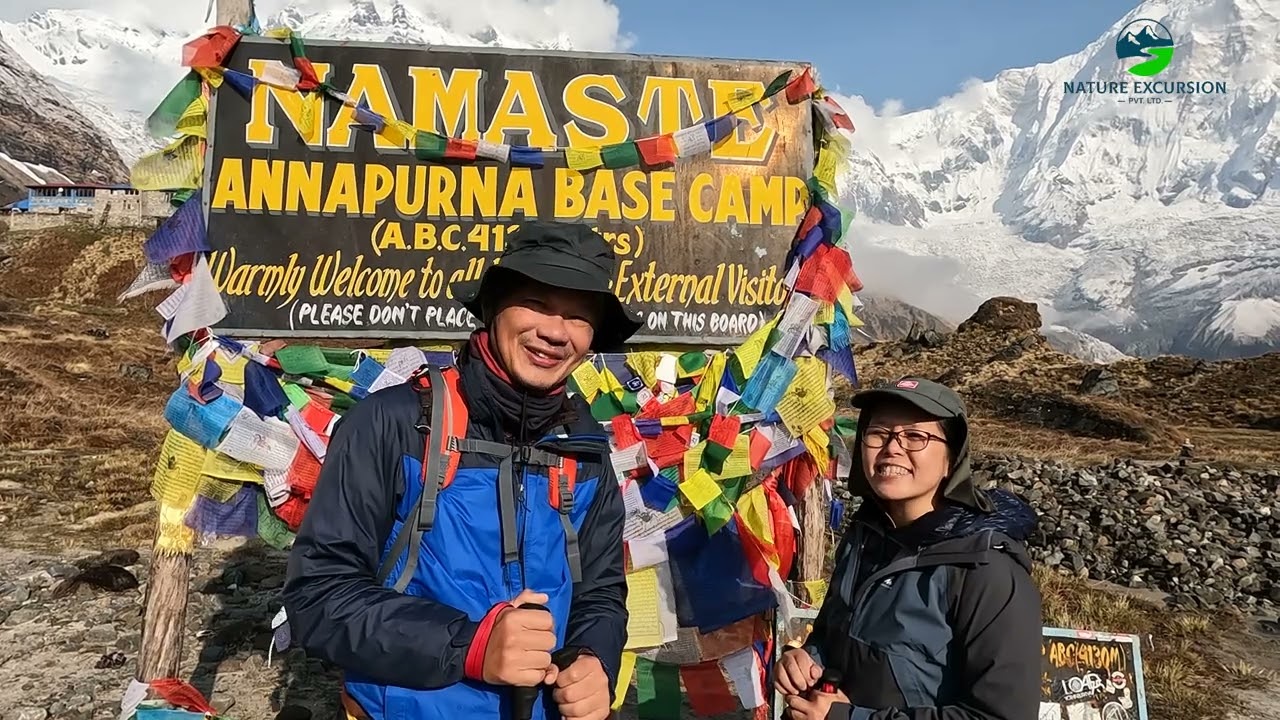
Annapurna Base Camp Trek with Helicopter Return 9 Days

Quick Facts
  • Trip Duration9 Days
  • Destination Nepal
  • Difficulty Level Moderate
  • Maximum Altitude 4,130 m/13,550 ft (Annapurna Base Camp)
  • Activity Trek
  • Starts/Ends Kathmandu/Kathmandu
  • Group Size 1 - 16
  • Transportation Drive Kathmandu-Pokhara-Nayapul & Helicopter flight from ABC-Pokhara
  • Best Season Spring & Autumn

Trail Psychology

How You Feel During the Trek

Thrilled→ Peaceful→ Determined→ Push→ Appreciation→ Awe

  • Thrilled: The ABC Trek with Heli Return begins with a scenic drive from Kathmandu to Pokhara, and then to Nayapul. The drive replaces busy city streets with open hillsides, building a sense of adventure for the mountain path ahead.
  • Peaceful: Walking through villages such as Tikhedhunga, Ghorepani, and Tadapani, you feel calm and centered as you walk through terraced fields, distant river sounds, and gentle forest trails.
  • Determined: The climb from Tadapani to Chhomrong, and to the Himalaya Hotel, steepens with stone steps and rocky paths. Your breathing deepens, and your legs feel heavy, but your internal determination keeps you moving toward the gateway of the sanctuary.
  • Push: You start pushing from the Himalaya Hotel to Deurali, and then towards MBC and ABC. The destination is extremely close, and there is no option of turning back now.
  • Appreciation: At Annapurna Base Camp, you are surrounded by majestic peaks like Annapurna I and Machhapuchhre. You will appreciate the hard journey it took to earn this stunning reward.
  • Awe: After taking the helicopter from ABC back to Pokhara, you get a bird’s eye view of different stunning mountain ranges. You will also see the trails that you spent days trekking through, which generates a sense of awe.

Emotions You May Feel

  • Thrilled
  • Peaceful
  • Determined
  • Push
  • Appreciation
  • Awe

How does your mind change?

  • Start: You feel calm.
  • Middle: You try harder.
  • Near Base Camp: You feel determined.
  • At the highest point: You are in awe.
  • Coming back: You feel peace.
  • Confidence Level: This trek builds confidence through steady, gradual altitude gain.

Connection and Solitude Ratio

  • Connection Level: 65% (Pokhara, Ghorepani, Chhomrong)
  • Solitude Level: 35% quiet alpine zones (Himalaya Hotel, Machhapuchhre Base Camp, Annapurna Base Camp)

Why You'll Love This Trip

  • An adventurous journey to the base of the tenth-highest mountain in the world, Mount Annapurna.
  • Enjoy a thrilling helicopter flight from the Base Camp to Pokhara.
  • Get to see the stunning beauty of the Annapurna region as you trek through lush forests and traditional villages.
  • Explore rivers, streams, waterfalls, dense forests, rolling hills, moraines, and glaciers.
  • Spend every night in villages along the trail, chit-chatting with locals and fellow trekkers.
  • Get to see the daily lifestyle and rich cultural heritage of the locals along the trail.
  • A perfect trek package if you are in quest of something different or wish to escape the return trek.
  • Spend a night at the Annapurna Base Camp.
  • Witness gorgeous sunrises and sunsets, diverse landscapes, and majestic mountain views throughout the trek.

Annapurna Base Camp Trek with Helicopter Return Overview

"Jobs fill your pocket, but adventures fill your soul." — Jamie Lyn Beatty

The Annapurna Base Camp with helicopter return is a classic trek that combines a challenging climb with a fast flight back to Pokhara. This trek takes you to the Annapurna Sanctuary, surrounded by the Annapurna massif. You walk through dense rhododendron forests and follow the Modi Khola river toward high alpine villages.

The trail passes through traditional Gurung settlements, such as Chhomrong and Himalaya, where you can see local mountain life. You eventually reach the natural basin of Annapurna Base Camp at the foot of Annapurna I at day 7, where giant mountains surround you on all sides. The ABC trek with helicopter return offers a unique way to see the Annapurna region by combining hiking and flying. You spend several days walking to the base camp to watch the sunrise over the massive ridges.

The best part of the Annapurna Base Camp Trek with heli return is that instead of hiking back down the same path, you take a helicopter flight back to Pokhara. This saves you several days of downhill trekking and gives you a bird’s eye view of the glaciers and deep valleys you just crossed. However, it is a little more expensive than other regular treks. If you are excited about the experience of the ABC trek and the return via helicopter, please consider this trek package.

Flow of Journey

The ABC Trek with Heli return journey starts with a scenic 7-hour drive from the streets of Kathmandu to the peaceful lakeside of Pokhara, following the Trishuli river. The drive continues the next day to Nayapul, where the trek officially begins along the Bhurungdi Khola, leading through Bamboo forests to Tikhedhunga

Things get a bit tougher as you tackle the famous 3,300 stone steps up to Ulleri, eventually making your way into the beautiful rhododendron forests of Ghorepani. You’ll wake up early for a hike to the top of Poon Hill, where you can watch a stunning golden sunrise over the massive Dhaulagiri and Annapurna peaks. From there, the trail heads through the mossy woods of Tadapani and down into Chhomrong, where you’ll get to experience the warm hospitality of the local Gurung people.

Moving deeper into the mountains, you’ll hike through the steep Modi Khola gorge and pass by the unique Hinku Cave as the air gets thinner and colder. The path leads you to Machhapuchhre Base Camp for a lunch break surrounded by giant peaks before you finish the final stretch to Annapurna Base Camp.

After spending a night right next to the glacier at 4,130 m, you’ll enjoy one last mountain sunrise before hopping into a helicopter. It’s a quick and scenic 20-minute flight that zooms over the trails you just walked, bringing you straight back to the comfort of Pokhara.

Itinerary

Day1
  • Accommodation:Hotel
  • Drive Distance:200 km
  • Drive Duration:6-7 hours
  • Sleep Elevation:830 m
  • Overnight Place:Pokhara
  • Day's Difficulty:Gentle

Our adventure to Annapurna Base Camp begins with a drive from Kathmandu at 7:00 AM. We will travel along the Prithvi Highway, which follows the rushing Trishuli River. This river is a hub for white-water rafting, and we may spot colorful rafts navigating the rapids below. The drive offers a front-row seat to rural Nepal, where we will see farmers working in their rice paddies and small roadside markets selling fresh local fruits. We typically stop for lunch at a riverside restaurant, allowing you to enjoy the subtropical air and hear the water before continuing west.

As the road nears the halfway point at Mugling, the scenery shifts toward the Marsyangdi River valley. On clear days, we will get to see the distant peaks of the Ganesh Himal and Manaslu. The final stretch of the drive brings us to Pokhara, where the climate feels noticeably fresher. We will arrive at the hotel near the vibrant Lakeside area in the late afternoon. This gives you plenty of time to go boating on Phewa Lake or enjoy a quiet dinner in your teahouse before going to bed.

Included activities:

  • Scenic drive along the Prithvi Highway.
  • Views of rural Nepali farms and markets.
  • Evening exploration or boating at Phewa Lake in Pokhara.
Day2
  • Meals:Breakfast, Lunch, Dinner
  • Accommodation:Teahouse
  • Trek Distance:9-10 km
  • Trek Duration:3-5 hours
  • Sleep Elevation:1,480 m
  • Overnight Place:Tikhedhunga
  • Day's Difficulty:Gentle

Day 2 begins with a two-hour drive from Pokhara toward the mountain gateway of Nayapul. The road winds through lush hills and small trading towns, offering us first clear views of the sharp, pointed peak of Machhapuchhre. After reaching Nayapul, we will complete a short walk to Birethanti, a busy village sitting at the confluence of the Modi and Bhurungdi rivers. Here, the guide will handle the necessary permits at the ACAP checkpoint while you observe the local life and mule caravans preparing for their journey into the high country.

The trail from Birethanti follows the north bank of the Bhurungdi Khola, taking us through vibrant bamboo forests and past several small waterfalls. We will walk on a relatively flat path that cuts through fertile terraced fields where local farmers grow millet and corn. The air stays warm and humid at this lower altitude, making the forest's shade very welcome. Our walk ends with a short, steady climb into the hillside settlement of Tikhedhunga. This village is famous for its colorful lodges and the sound of the nearby river, providing a peaceful spot to rest before tomorrow’s steep ascent.

Included activities:

  • Two-hour mountain drive to the gateway of Nayapul.
  • Permit registration at the Birethanti ACAP checkpoint.
  • Walk through Bamboo forests, millet, and corn farms.
  • Peaceful rest at Tikhedhunga.
Day3
  • Meals:Breakfast, Lunch, Dinner
  • Accommodation:Teahouse
  • Trek Distance:10-13 km
  • Trek Duration:5-7 hours
  • Sleep Elevation:2,874 m
  • Overnight Place:Ghorepani
  • Day's Difficulty:Gentle

Our day begins with a famous challenge: crossing a suspension bridge and starting the climb up the Ulleri stairs. This steep section consists of more than 3,300 stone steps carved into the hillside. As we gain height, the views open up to reveal the white peaks of Annapurna South and Hiunchuli. We will pass through the village of Ulleri, where traditional stone houses with slate roofs cling to the steep slopes. The hard work on the stairs pays off with a lunch stop in a local teahouse to enjoy the cooler mountain air.

The trail then softens as we enter a deep forest of oak and rhododendron. If we travel in the spring, these woods come alive with bright red and pink blossoms. This area is home to the Himalayan Monal, Nepal’s national bird, so keep an eye out for its colorful feathers. The final stretch takes you through Banthanti and Nangge Thantibefore we reach the blue-roofed houses of Ghorepani.

After arriving in the afternoon, we can head to the balcony of a local teahouse in Upper Ghorepani. These terraces are perfect for watching the light change over the Dhaulagiri and Annapurna massifs. If you still have energy, a short walk allows you to see the traditional stone architecture and prayer flags of the Magar community. You can also visit the Poon Magar Museum to learn about the history of the brave Gurkha soldiers before returning to your teahouse for the night.

Included activities:

  • Climb up the 3,300 stone steps of the Ulleri stairs.
  • Birdwatching for the Himalayan Monal in oak and rhododendron forests.
  • Visit the Poon Magar Museum to learn about Gurkha history.
Ghorepani Entrance
Ghorepani Top View
Trek to Ghorepani
Day4
  • Meals:Breakfast, Lunch, Dinner
  • Accommodation:Teahouse
  • Trek Distance:11-12 km
  • Trek Duration:6-7 hours
  • Sleep Elevation:2,590 m
  • Overnight Place:Tadapani
  • Day's Difficulty:Moderate

Following the 9-day Annapurna Base Camp with Heli Return itinerary, today morning begins at 5:00 AM with a steady climb to the Poon Hill View Tower. The trail is a steady challenge, consisting of a steep climb up stone stairs for about 45 minutes. Before we reach the summit, we will stop at the local ticket barrier to pay a small entry fee of NPR 50. Joining other trekkers in the pre-dawn quiet, we will make our way to the Poon Hill View Tower just in time to watch the first light hit the peaks.

It’s better to reach the viewpoint before dawn, and you can grab a warm drink from the local tea stall while waiting for sunrise. When the sun finally breaks over the horizon, the peaks of Dhaulagiri and Annapurna South turn a golden color. From here, we will also get to see the pointed summit of Machhapuchhre and the distant peaks of the Ganesh Himal range.

After descending to Ghorepani for a warm breakfast, we will head east toward Thapla Danda. We get great views at high altitude before entering a beautiful old-growth rhododendron forest. The trail leads us through the narrow pass at Deurali and down into the moss-covered valley of Banthanti (2,100).

We will cross several wooden bridges over rushing mountain streams before a final short climb brings us to Tadapani. This village sits on a high saddle, offering a face-to-face view of the mountains that feels so close we could almost touch them.

Included activities:

  • Pre-dawn hike to the Poon Hill View Tower for sunrise.
  • Trekking through old-growth rhododendron and moss-covered forests.
  • Crossing mountain streams via traditional wooden bridges.
Day5
  • Meals:Breakfast, Lunch, Dinner
  • Accommodation:Teahouse
  • Trek Distance:9 km
  • Trek Duration:5-6 hours
  • Sleep Elevation:2,340 m
  • Overnight Place:Chhomrong
  • Day's Difficulty:Moderate

Our journey continues today from Tadapani to Chhomrong with a steep descent through a deep, moss-covered maple and oak forest. As we pass through the thick green canopy, we might spot gray langur monkeys swinging through the branches. As we emerge from the trees, the trail opens up to reveal the Chuile village, offering a wide view of the terraced hillsides. From here, we will walk down a series of stone steps through vibrant farmland until we reach the suspension bridge over the Kimrong Khola.

After crossing the river, we will begin a steady uphill climb toward the village of Ghurjung. This Gurung settlement is surrounded by neat rows of maize and potato fields, providing a glimpse into the daily lives of the local farmers.

The trail then leads us past Top Danda. This ridge is known for its wide views of the valley below. The final stretch of the day involves a gradual but persistent climb on stone paths. We will eventually reach Chhomrong, the last permanent settlement on the route, which offers a stunning, front-row view of Annapurna South and Machhapuchhre.

Included activities:

  • Wildlife spotting of gray langur monkeys in the maple forest.
  • Walking through Ghurjung, the traditional Gurung village.
  • Crossing the suspension bridge over the Kimrong Khola river.
  • Stop at Top Danda to enjoy the views of the mountains.
Random picture on the way
Place from Chhomrong
Suspension bridge
On the way to Chhomrong
Day6
  • Meals:Breakfast, Lunch, Dinner
  • Accommodation:Hotel
  • Trek Distance:14 km
  • Trek Duration:7-8 hours
  • Sleep Elevation:2,900 m
  • Overnight Place:Himalaya Hotel
  • Day's Difficulty:Moderate

Day 6 trek starts from Chhomrong and ends at the Himalaya Hotel. First, we begin with a steep descent down more than 2,500 stone steps to the Chhomrong Khola. After crossing the suspension bridge, we will begin a steep, rhythmic climb toward Sinuwa. This section of the trail is physically demanding, but the views of the Annapurna Sanctuary opening up ahead provide a great distraction.

We will once again stop at the ACAP checkpoint here to register our permits. As we move past UpperSinuwa, we enter a strictly protected zone where the local community considers the mountains sacred. To respect these ancient beliefs, no meat products are served in the teahouses beyond this point.

The trail takes us through a cool, shaded forest of bamboo, oak, and rhododendron, occasionally dropping to the river. After lunch in Bamboo, we’ll continue to Dovan, passing a shrine to Lord Shiva near beautiful waterfalls. Because mountains are believed to be sacred, we'll notice that even pack animals like donkeys are restricted beyond Dovan. We'll spend the night at the Himalaya Hotel in the Modi Khola gorge.

Included activities:

  • Rhythmic descent and ascent of the famous Chhomrong stone stairs.
  • Visit to the Hinku Cave and the Lord Shiva forest shrine.
  • Trekking through the deep gorge of the Modi Khola River.
Day7
  • Meals:Breakfast, Lunch, Dinner
  • Accommodation:Teahouse
  • Trek Distance:10 km
  • Trek Duration:6-7 hours
  • Sleep Elevation:4,130 m
  • Overnight Place:Annapurna Base Camp
  • Day's Difficulty:Challenging

Our ascent today brings us into the heart of the Annapurna Sanctuary, beginning with a steady climb toward Hinku Cave. The trail leads us through dramatic glacier-carved landscapes and across cautious landslide sections toward Deurali.

A unique highlight of this stretch is the natural formation on the cliffs across the valley, where the rock face appears to reveal a naturally engraved silhouette of Gautam Buddha. This sight adds a spiritual layer to your journey as the alpine vegetation thins and the massive walls of the Annapurna Sanctuary begin to close in.

As we reach Machhapuchhre Base Camp (3,700 m), the trail levels out into a high-altitude plateau. Though climbing this sacred "Fishtail" peak is strictly forbidden, MBC serves as a calming lunch stop with 360-degree views of the Annapurna Massif.

The final two-hour walk to Annapurna Base Camp (4,130 m) is a gentle but thin-aired climb across the moraine. Upon arrival, we can stand by the iconic ABC signboard for a victory photo before settling into the lodge. Nestled right beside the South Annapurna Glacier, we will witness a spectacular sunset where the surrounding 8,000 m peaks glow with a deep golden light.

Included activities:

  • Viewing the natural "Buddha Silhouette" engraved on the valley cliffs.
  • High-altitude lunch stop at the sacred Machhapuchhre Base Camp.
  • Final glacier-side trek to the Annapurna Base Camp (4,130 m).
Our group at top
Everyone completed the trip
View from ABC
A memorable journey to ABC
Day8
  • Meals:Breakfast, Lunch
  • Accommodation:Hotel
  • Sleep Elevation:4,130 m
  • Overnight Place:Annapurna Base Camp
  • Day's Difficulty:Challenging

Our last morning in the Annapurna region is beautiful and bright. We will get up early to see the first light of the sun hit the peak of Annapurna I, the 10th-highest mountain in the world. The mountain changes from a cold blue to a warm gold, a powerful sight from the base camp. After a hearty breakfast at the lodge, we will descend to Machhapuchhre Base Camp and take a helicopter for a quick 20-minute flight back to Pokhara. As the helicopter takes off, we will see a final view of the deep Modi Khola gorge and the winding trails we walked for days. 

The flight goes over the lush, terraced hills and traditional villages of the Gurung people, with the sacred Machhapuchhre peak on our right. When you land in Pokhara, you will be taken back to Lakeside. You can spend the rest of your day exploring Pokhara Valley. There are plenty of places to explore in Pokhara, such as Davis Falls, Mahendra Cave, and Gupteshwor Cave, etc.

In the evening, you will return to the Lakeside area, where you can engage in boating and visit the nearby temple. In the evening, you can celebrate reaching ABC with your crew before dinner and bed.

Included activities:

  • Sunrise photography of Annapurna I and the surrounding peaks.
  • 20-minute helicopter flight from Machhapuchhre Base Camp to Pokhara.
  • Aerial views of Modi Khola gorge and Gurung villages.
  • Explore Pokhara valley, and relax on the lakeside.
Helicopter landing on ABC
Helicopter coming to pick up our group
Day9
  • Meals:Breakfast, Dinner
  • Accommodation:Hotel
  • Sleep Elevation:1,400 m
  • Overnight Place:Kathmandu
  • Day's Difficulty:Gentle

Today is our final day on the Annapurna Base Camp Trek with a Heli return. We will depart around 7:30 AM for the journey back to Kathmandu. The drive follows the highway along the river, where we can watch the green hills and local villages pass by the vehicle window. You will have several stops for snacks and lunch as the road winds through the central valleys. Once you reach Kathmandu, we will drop you off at your hotel so you can shower and rest after the long drive.

In the late afternoon, you can walk through the busy streets of Thamel for some last-minute shopping. You might find handmade crafts or local tea to take home as gifts. To celebrate your successful journey to the base camp, we will host a farewell dinner in the evening. You can enjoy a final meal of traditional food and share stories of your adventure with your team.

Included activities:

  • Scenic drive from Pokhara to Kathmandu.
  • Explore Thamel and browse local shops and cafés.
  • Join a farewell dinner in the evening.

Download our Annapurna Base Camp with Heli return itinerary to save three days of tough downhill walking and protect your knees from thousands of steep stone steps. You will find clear maps, altitude charts, and packing lists that help you prepare for the 4,130 m climb without the stress of planning every detail yourself.

Download Pdf

Cost Details

Includes

  • Free airport pickup and drop-off services during the arrival and departure dates
  • Transportation costs from Kathmandu to Pokhara to Nayapul, and from Pokhara to Kathmandu
  • Heli cost from Annapurna Base Camp to Pokhara
  • All meals during the trek in the Himalaya (8 breakfasts, 9 lunches, and 7 dinners)
  • Tea houses and lodges during the trek in the Himalaya
  • Hotel in Pokhara 2 nights before and after trek completion
  • Government-licensed, English-speaking, experienced Nature Excursions native guide with his meals, salary, transportation, insurance, and all necessary equipment. An assistant guide group of 6 or more trekkers
  • Strong Sherpa/porter to help your luggage; 1 porter for two trekkers (luggage weight limit is 10 kg per trekker)
  • Trekking Information Management System (TIMS) card fees
  • Annapurna Conservation Area Permit (ACAP) fees
  • All government, local taxes, and official expenses
  • Down jacket and sleeping bag as per your request (has to be returned after the trek completion)
  • Snacks (cookies) and seasonal fresh fruit every day
  • Purification tablets for safe drinking water
  • The first-aid kit box carried by the guide
  • Company t-shirt
  •  Farewell dinner

Excludes

  • International flight fare
  • Nepal entry visa fees at Tribhuvan International Airport (TIA), 15 days: $ 25
  • All hotels and meals in Kathmandu, except the farewell dinner
  • All meals and hotel in Pokhara due to late departure or early return from the trek than schedule itinerary
  • Personal expenses, such as tea/coffee, hard and soft drinks, shopping, boiled water, hot bag, internet, hot shower, laundry, extra porter, etc.
  • Personal clothing and gear
  • All the costs and expenses that are not listed in the included section
  • Travel insurance, which has to cover emergencies, high-altitude rescue, and evacuation
  • Additional costs due to delays caused by circumstances beyond our control, like landslides, itinerary modifications due to safety concerns, weather conditions, illness, changes in government policies, and strikes
  • Tips for the guide and porter. 

Annapurna Base Camp Trek with Helicopter Return 9 Days pictures and video

Annapurna Base Camp Trek /ABC-2023/ Annapurna Sanctuary

Clients Reviews

  • Reached Annapurna Base Camp -What a joy.

    What an achievement! We just completed trekking to the Annapurna Base Camp in May 2024.
    We did it with the guidance and help from our guide, Raju Gurung and his team.
    What an experience of various challenges and camaraderie among us as we trekked along to reach ABC. Such experience will stay with us for a long, long time.
    We are grateful to our knowledgeable and caring guide who led us through to ABC.
    Our guide and his team brought so much fun, laughter and inspiration to us as we trekked along.
    Thank you, Raju and team. You are a great team.

    Ks Woon
    Ks WoonMalaysiaMay 12, 2024
    TripAdvisor
  • Best views and lifetime experience made possible by the best team from Nature Excursion!

    Had a phenomenal ABC experience with Nature Excursion! The guides and porters were very experienced and will go extra miles to make sure we are doing well. Everything (accommodation, meals, logistics) was taken care of by the team. I'm very impressed with their professionalism and hospitality that warms the heart. Will definitely sign up for more treks in the future with Nature Excursion! Kudos for the exceptional service!

    SzeMin Ngoo
    SzeMin NgooMalaysiaMay 12, 2024
    TripAdvisor

Useful Information

Does Choosing a Helicopter Return Make the Annapurna Base Camp Trek Less Difficult?

Choosing a helicopter return from Annapurna Base Camp (ABC) significantly lowers the physical demand of the journey. A standard trek requires you to walk back down the same trails you climbed, which puts heavy pressure on your knees and joints. By flying back to Pokhara, you remove three to four days of steep downhill hiking. This makes the trip accessible for people with limited time or those who worry about their physical stamina on the return leg.

While the flight saves your legs from the descent, it does not change the difficulty of the ascent. You still must hike up to 4,130 m on your own power to reach the Annapurna Sanctuary. The risk of altitude sickness and the challenge of climbing thousands of stone stairs remain exactly the same. A helicopter return is a smart way to manage your energy, but you still need to prepare for a rigorous uphill climb during the first half of the trip.

Routes, Mountains & Experience in ABC Heli Return Trek

The Annapurna Base Camp trek with a helicopter return offers a mix of local culture and high-altitude adventure. You will walk through alpine forests and traditional villages to reach the heart of the Annapurna Sanctuary. This route provides a faster way to see the massive peaks without walking the same path back to Pokhara.

The trail features many stupas and prayer flags that reflect the local heritage. Along the way, you can see 8,000 m giants like Annapurna I and Dhaulagiri, alongside the sharp peak of Machhapuchhre (6,993 m). The journey includes views of glaciers, moraines, and waterfalls that change as you gain altitude.

After passing the Upper Sinuwa, the path becomes narrow and steep as you enter the high mountain zone. You will pass the Hinku Cave and Machhapuchhre Base Camp before reaching your final destination at 4,130 m. The trail is steep, rocky, and narrow until you reach ABC. Unlike the Everest base camp Trek, you will spend a night at the Annapurna Base Camp.

There are a few lodges at the base camp where trekkers can spend the night. Waking up with a spectacular view is one of the best moments of the Annapurna Base Camp trek with a helicopter return. To take the helicopter, you have to descend to Machhapuchhre Base Camp.

Mountain Peaks Visible on the Trek

MountainAltitude
Annapurna I8,091 m
Dhaulagiri8,167 m
Nilgiri7,061 m
Machhapuchhre6,993 m
Hiunchuli6,441 m

Accommodation and Meals During the Annapurna Base Camp Trek with Helicopter Return

In Kathmandu and Pokhara, you will spend nights in three-star hotels. During trekking, you will spend nights in lodges. The Annapurna Base Camp trekking route is lined with lodges and teahouses to accommodate trekkers. Our team will book the best lodges for you. We will try to book rooms with private washrooms, but they may not be available in all villages. The rooms will be twin-shared and offer clean bedding.

The lodges along the ABC trail offer a diverse menu. The menu will be mostly the same in all places. Nepali dishes are commonly available, along with a few Western and Tibetan dishes. Oats, muesli, toast with jam, eggs, sausage, fruits, sandwiches, porridge, thukpa (a Tibetan noodle soup), roti with veggies, paratha, etc., are mostly available for breakfast. For lunch and dinner, there are dal bhat, pasta, momo, burgers, pizza, thukpa, thenduk, Tibetan bread, etc.

Can We Go to Annapurna Base Camp by Helicopter Round-Trip Year-Round?

Although it is possible, you have to be careful when planning the Annapurna Base Camp trek with a helicopter return. Picking the right route is crucial for this trek, as it also involves a helicopter flight. Spring (March to May) and autumn (September to November) are the best times to do the Annapurna Base Camp trek with a helicopter return. Likewise, summer/monsoon (June to August) and winter (December to February) are off-season for this trek. 

Spring and autumn have stable weather needed for trekking and flying in the Himalayas. The views are fantastic, and the climate is pleasant for walking 5 to 7 hours a day. The nights and mornings are chilly, while daytime temperatures are warm. Whereas summer/monsoon and winter are characterized by unstable weather, which delays and cancels helicopter flights. When planning treks during the offseason, such as summer, monsoon, and winter, thorough preparation is essential. 

Annapurna Base Camp with Heli Return Trail Weather Variations

The Annapurna Base Camp Trek with Helicopter Return is an adventure that takes you through diverse landscapes and climates. The trek begins with a warm, low-altitude valley around Pokhara, then slowly climbs through cool settlements like Ghorepani, until you reach the cold alpine villages like the Himalaya Hotel. The trek ends at Annapurna Base Camp, a stunning glacier camp at over 4,100 m. Below is a clear explanation of how the weather changes during the trek based on altitude and season.

Low Altitudes (Pokhara-Ghorepani)

  • Winter (Dec–Feb): 50°F to 32°F (10°C to 0°C)
  • Spring (Mar–May): 77°F to 50°F (25°C to 10°C)
  • Summer (Jun-Aug): 86°F to 68°F (30°C to 20°C)
  • Autumn (Sept–Nov): 73°F to 45°F (23°C to 7°C)

Mid Altitudes (Tadapani-Chhomrong)

  • Winter (Dec–Feb): 32°F to 14°F (0°C to -10°C)
  • Spring (Mar–May): 59°F to 32°F (15°C to 0°C)
  • Summer (Jun-Aug): 68°F to 50°F (20°C to 10°C)
  • Autumn (Sept–Nov): 55°F to 28°F (13°C to -2°C)

High Altitudes (Himalaya Hotel-Machhapuchhre Base Camp-Annapurna Base Camp)

  • Winter (Dec–Feb): 14°F to -4°F (-10°C to -20°C)
  • Spring (Mar–May): 32°F to 23°F (0°C to -5°C)
  • Summer (Jun-Aug): 59°F to 41°F (15°C to 5°C)
  • Autumn (Sept–Nov): 32°F to 14°F (0°C to -10°C)

Best Season for Annapurna Base Camp Trek with Helicopter Return

Choosing the best time for your Annapurna Base Camp helicopter tour ensures you get clear views of the 8,000 m peaks. While the flight is available throughout the year, spring and autumn offer the most stable weather and sharpest visibility. Flying during the busy months helps you avoid cloud cover and flight delays. This means you can land safely at 4,130 m and enjoy the vast Annapurna Sanctuary.

Spring (March to May):

Spring is a favorite for trekkers because the landscape is full of life. This is the time when the rhododendron forests are in full bloom, covering the lower hills in shades of red and pink. The trails are generally dry, though you might find some melting snow near the Machhapuchhre Base Camp in early March. The helicopter return is especially popular in spring because it offers a bird’s-eye view of the colorful forests you just walked through, and you don't have to walk along the melting snow, which can be slippery. The morning air is usually calm, providing a steady flight back to Pokhara. By May, the weather gets warmer, but afternoon clouds can build, so early morning flights are best.

  • Trail Details: Dry paths with blooming flowers; some lingering snow at high altitudes.
  • Temperature: 10°C (50°F) to 20°C (68°F) during the day and -5°C (23°F) to 0°C (32°F) at night.
  • Heli Context: High success rate for morning flights.

Autumn (September to November):

Autumn is widely considered the best season for any Himalayan adventure. After the monsoon rains wash away the dust, the air is incredibly clear. This season provides the sharpest views of Annapurna I (8,091 m) and the surrounding glaciers. The weather is very stable, making it the safest time for helicopter operations. During these months, the trail is firm and easy to walk. Because this is the peak season, the base camp can be busy, which makes the helicopter return even more valuable. It allows you to skip the crowded downhill trails and return to the comfort of your Pokhara hotel in just 20 minutes.

  • Trail Details: Crisp, clear paths with the best mountain visibility of the year.
  • Temperature: 8°C (46°F) to 15°C (59°F) during the day and -10°C (14°F) to -5°C (23°F) at night.
  • Heli Context: Most reliable weather for flights; perfect for high-definition photography.

Annapurna Base Camp Heli Return vs Classic Descent: Time, Cost, and Experience Compared

Choosing between a helicopter return and the classic walk down changes the nature of your trip. The helicopter option is a premium choice that prioritizes speed and comfort. The classic descent is better for those who want a slower pace and have a tighter budget.

FeatureHelicopter ReturnClassic Descent
Total Duration7 to 9 days12 to 13 days
Descent Time20 minutes to Pokhara3 to 4 days of walking
Physical EffortHigh on ascent, none on returnConsistent effort for the full trip
Package PriceUSD 1,500 to USD 2,500USD 700 to USD 1,100
SceneryAerial views of glaciers and peaksClose-up views of forests and rivers
Trail ExperienceFocuses on the climb to the topIncludes more villages like Ghandruk
Best ForLimited-time trekkers or luxury seekersBudget travelers 

The Real Reason Spring Has More Heli Delays Than Autumn at ABC

        Trekking to Annapurna Base Camp (ABC) offers two distinct windows for clear weather: spring and autumn. While many trekkers expect identical conditions, the atmospheric behavior in these seasons is quite different. You will find that spring often brings higher humidity and heat, creating more cloud cover and wind than the stable, dry air of the autumn months.

        The primary reason for spring delays is the rapid warming of the Earth. As the sun gets stronger in April and May, it heats the valley floors. This warm air rises and carries moisture from the lower forests up into the high mountains. By 10:00 AM, this moisture forms thick clouds that sit within the Annapurna Sanctuary. Helicopters need clear visibility to fly through the narrow mountain passes. In the autumn, the air is much colder and holds less water. This means the sky stays clear for a longer part of the day, which allows more flights to land and take off safely.

        Another core reason for spring heli delays is wind patterns and thermal activity. Spring is a time of change, often with unsettled weather. Warmer temperatures create rising air currents that can make flying bumpy. As the day progresses, these winds get stronger, making it tough for pilots to land planes on the small helipad over 4,000m. 

        Similarly, haze is another major factor that people often overlook in the spring. During this time, dust from the plains and smoke from seasonal forest fires settle in the air. This creates a thick layer of haze that reduces horizontal visibility, even if the sky above looks blue. Pilots must be able to see several kilometers ahead to navigate the steep terrain safely.

        Annapurna Base Camp Trek with Helicopter Return 9 Days FAQs

        • The cost of the Annapurna Base Camp trek with a helicopter return varies depending on several factors, including the number of participants, helicopter availability, and specific preferences. Please contact our team for a personalized quote and detailed pricing information. In general, the Annapurna Base Camp trek with a helicopter return costs between USD 1,800 and USD 4,500 per person. 

        • The best time to trek to Annapurna Base Camp (ABC) is during the spring (March to May) and autumn (September to November) seasons. These months offer stable weather, mild temperatures, and clear skies, making for optimal trekking conditions. 

        • Annapurna Base Camp (ABC) experiences cold temperatures, particularly at night and during the winter months. In the peak trekking seasons of spring and autumn, nighttime temperatures can drop to around -5°C to -10°C (23°F to 14°F). However, during the winter (December to February), the cold can be much more intense, with nighttime temperatures plummeting to -15°C to -20°C (5°F to -4°F ).

        • The Annapurna Base Camp trek with a helicopter return is considered moderate in difficulty. While the trek itself is manageable for individuals with a basic level of fitness, it still requires approximately 5-7 hours of trekking a day over varied terrain, including forests and uneven paths.

        • Yes, it's mandatory to have a guide for the Annapurna Base Camp trek. A guide can provide valuable assistance with navigation, ensure your safety, handle logistics, and offer insights into local culture. 

        • Some lodges along the trekking route offer paid WiFi, but connection quality may vary. Be prepared for limited or no internet access during your trek. Nepali tourist sim offers better connectivity.

        • Annapurna Base Camp (ABC) is famous for its beautiful natural beauty and stunning mountain vistas. Nestled within the Annapurna Sanctuary, it offers trekkers close-up views of towering peaks, including the Annapurna range, Dhaulagiri range, Machapuchare, and numerous other mountains.

        • Yes, a beginner can undertake the Annapurna Base Camp trek with a helicopter return. The trek itself is moderate in difficulty and involves several hours of daily trekking, sometimes on uneven terrain. The helicopter return option adds convenience but does not eliminate the need for basic fitness and proper acclimatization.

        • When trekking to Annapurna Base Camp, dress in layers to adapt to changing weather conditions. Begin with moisture-wicking base layers to keep sweat away from your skin. Add insulating layers, like a fleece or down jacket, for warmth, and a waterproof, windproof outer shell to protect against rain and wind.

        • To trek to Annapurna Base Camp, you must obtain the Annapurna Conservation Area Permit (ACAP). Previously, the Trekkers' Information Management System (TIMS) card was mandatory, but it is no longer required. The ACAP permit mandatory for all foreign hikers and are checked at several points along the trail to ensure safety and support local conservation efforts.

        You may also like

        SimilarPackages