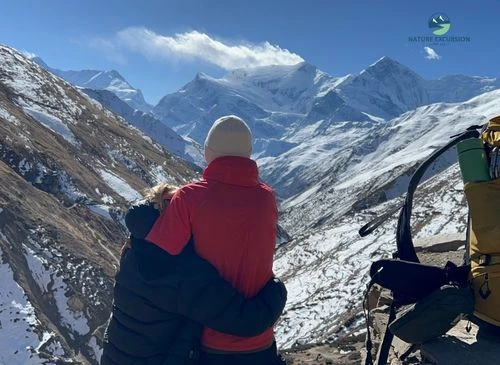
Short ABC Trek Weather Variations
The Annapurna Base Camp short Trek takes you through different climates over a short distance. It starts in the warm valleys around Pokhara and slowly climbs through cool rhododendron forests. Then, it reaches the cold alpine areas. Finally, it ends at the beautiful glacial basin of Annapurna Base Camp, at an elevation of over 4,100 m above sea level. Below is a clear explanation of how weather conditions change during the trek by altitude and season.
Low Altitudes (Pokhara-Jhinu Danda)
- Winter (Dec–Feb): 50°F to 32°F (10°C to 0°C)
- Spring (Mar–May): 77°F to 50°F (25°C to 10°C)
- Summer (Jun-Aug): 86°F to 68°F (30°C to 20°C)
- Autumn (Sept–Nov): 73°F to 45°F (23°C to 7°C)
Mid Altitudes (Upper Sinuwa – Deurali)
- Winter (Dec–Feb): 32°F to 14°F (0°C to -10°C)
- Spring (Mar–May): 59°F to 32°F (15°C to 0°C)
- Summer (Jun-Aug): 68°F to 50°F (20°C to 10°C)
- Autumn (Sept–Nov): 55°F to 28°F (13°C to -2°C)
High Altitudes (Annapurna Base Camp)
- Winter (Dec–Feb): 14°F to -4°F (-10°C to -20°C)
- Spring (Mar–May): 32°F to 23°F (0°C to -5°C)
- Summer (Jun-Aug): 59°F to 41°F (15°C to 5°C)
- Autumn (Sept–Nov): 32°F to 14°F (0°C to -10°C)
Best Season for the Short Annapurna Base Camp Trek
The best seasons to trek to ShortAnnapurna Base Camp are spring (March to May) and autumn (September to November). The weather is ideal during these months. You will enjoy stable temperatures and clear skies. The trails are well-defined, making it easier to trek.
Spring (March to May):
Trekking ABC during spring is a wise decision. The trails are beautiful, filled with blooming rhododendrons and lush greenery. Clear skies offer stunning views of the Annapurna range, making this season ideal for trekkers seeking both breathtaking scenery and easy access. It's the perfect combination of value and natural beauty.
Autumn (September to November):
Trekking to Annapurna Base Camp in autumn (September to November) is ideal due to stable weather, clear skies, and comfortable temperatures. After the monsoon, the landscape is lush, and the visibility of the Annapurna Range and Machhapuchhre is excellent. Daytime temperatures are pleasant for trekking, while nights are cooler at higher elevations. Trails are dry, views are sharp, and the risk of heavy snowfall is low, making this period great for both beginners and experienced trekkers.
Who the Annapurna Base Camp Short Trek Is Really For and Who Should Avoid It?
The 7-Day Annapurna Base Camp short Trek is a challenging route that reaches an elevation of about 4,130 m and involves 5–7 hours of walking daily across terrain such as stone steps and forest trails. It’s a moderate trek that requires good fitness but no climbing skills. This shorter version intensifies altitude gain and daily walking, so your fitness, stamina, and altitude tolerance are important for success.
Who Is The Short ABC Trek For?
The trek is ideal for trekkers with good basic fitness and strong endurance who can comfortably walk 5–7 hours per day over multiple days. It suits active travelers, hikers with some hill-walking experience, and motivated first-time trekkers who prepare physically before the trip.
The route is easy to follow and is suitable for people with average to good fitness levels. It involves walking uphill and downhill, so you should be comfortable with this type of activity. The trek requires a light pack, making it manageable even for travelers with limited time. It offers a high-altitude Himalayan base camp experience, providing stunning views of glaciers and mountains without requiring mountaineering skills.
Who Should Avoid It
Although ABC Trek is not complicated or technical, it is absolutely not suitable for people with serious heart or lung conditions. Also, anyone who has recently undergone major surgery or who cannot walk for several hours during the day should avoid this trek. It is also not ideal for those with very low fitness, a strong fear of heights, or a history of severe altitude sickness without proper acclimatization planning.
Furthermore, very young children, elderly trekkers, those with no hiking experience, or trekkers expecting a relaxed, slow-paced trek should opt for a longer-duration trek and avoid the 7 Days ABC Trek.
What Makes the 7-Day Annapurna Base Camp Short Trek Challenging?
The short Annapurna Base Camp Trek difficulty, ranging from moderate to challenging, depends on experience and fitness. However, if the duration is short, like 7 days, the challenge increases due to a tight schedule that allows few days for rest or a gradual increase in altitude. The trail is clear and easy to follow, but the steep climbs, long walking days, and changing terrain make this short trip challenging both physically and mentally.
Rapid Altitude Gain
One of the biggest challenges we face during the 7-day Annapurna Base Camp (ABC) trek is the extremely rapid ascent to high altitude. We reach an elevation of over 4,000 m after only 2 days of trekking, leaving us little time to acclimatize properly. For example On Day 1, we start at around 830 m in Pokhara and trek to Sinuwa at 2,340 m, gaining approximately 1,510 m in elevation in a single day.
Similarly, on Day 2, we continue from Sinuwa (2,340 m) to Deurali at 3,230 m, gaining another 890 m in elevation. And just the next day, we reach the ABC, which is over 4,000m. This steep, back-to-back climb means our bodies have minimal time to adjust. Therefore, it’s essential that we acclimatize carefully between stages, maintain a slow, steady pace, stay well hydrated, monitor our breathing, and watch closely for early signs of altitude sickness to reduce the risk.
No Acclimatization Days
Shortening the trek to seven days requires trekkers to walk 5 to 7 hours a day, often without long breaks. Furthermore, there are no acclimatization days between treks to rest and regain strength, which increases fatigue and tiredness and makes us more prone to altitude sickness.
Faster Descent
After reaching Annapurna Base Camp (4,130 m), the return often involves a quick descent to Pokhara in just 2 days. While this quick descent helps alleviate altitude-related issues, the steep, rocky paths can strain the knees, ankles, and muscles, increasing the risk of pain or injury, especially after the climb.
Unpredictable Weather
In the Annapurna Sanctuary, we should be aware that the weather can change quickly, with cold temperatures, strong winds, rain, or snow, especially at night above 3,000 m. The trails can become slippery and dangerous, and the thin air makes it harder for us to breathe and stay warm, increasing our discomfort and risk.
How Do Meals and Accommodation Differ on the Short ABC Trek?
First, you will stay in developed cities such as Kathmandu and Pokhara. Here, you will stay in comfortable three-star hotels that are safe and offer a relaxing, luxurious environment. Once the trek begins, accommodation shifts to simple but clean tea houses. You will stay in the best available single or twin-share rooms based on your preference.
These lodges prioritize rest and recovery over luxury, which suits the demands of trekking. The rooms along the trail are small and practical. Depending on the location, you will either get private or shared bathrooms. These teahouses maintain clean bedding and provide blankets for warmth. However, the bedrooms are quite cold, so you may need to use your sleeping bags to keep warm.
For food, you will have three meals per day: breakfast, lunch, and dinner. You eat breakfast and dinner at the lodge where you stay, and you have lunch at teahouses along the trail. The menus in these teahouses are mostly local Nepali dishes that are easy to digest. Breakfast options include oats, toast with jam, eggs, muesli, porridge, etc.
Lunch and dinner menus are somewhat similar. It includes Dal Bhat (Rice and lentils), vegetable curry, pickle, dhindo, roti, etc. Some Western dishes are also available, including pizza, pasta, noodles, momo, and burgers. All teahouses provide clean drinking water, but use purification tablets, such as chlorine tablets, for added safety.
How the Body Adapts Differently on a 7-Day ABC Trek vs Longer Itineraries
On a 7-day Annapurna Base Camp trek, the body must adapt quickly to altitude changes because the schedule allows limited time for gradual acclimation. Breathing rate increases to increase oxygen intake, and the heart pumps faster to deliver it throughout the body. The body produces more red blood cells, but the process is incomplete. Furthermore, because ascent is faster, trekkers must manage pace, hydration, and rest carefully to reduce fatigue and the risk of altitude sickness.
On longer itineraries, the body adapts more fully because it gains extra days at mid- and high elevations. With a longer duration, you will have more time to rest and acclimate to the altitude. Your heart rate stabilizes and you breathe more easily.
A well-rested body produces more RBCs, which help increase endurance and accelerate muscle recovery. Nevertheless, gradually climbing to higher altitude will give you an advantage, which is the reason longer duration treks are more suitable than the Annapurna Base Camp short trek.


.webp)


-1-1771900058-18a070cd.webp)




.jpg)
.jpg)
.jpg)
.jpg)
-(1).webp)
 India
India.jpg)
.jpg)
-(1).webp)
.jpg)
.jpg)
.jpg)
-(1).webp)
 Belgium
 United States


.webp)