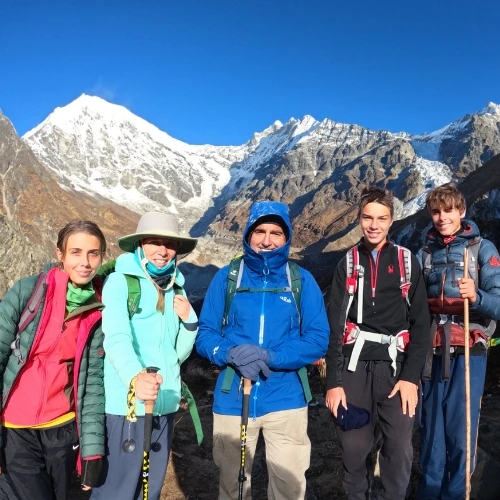
The Annapurna massif is a vast part of the Himalayas in north-central Nepal. It is not just one peak: it contains over thirty mountains. It is one of the most iconic ranges in central Nepal, attracting trekkers and climbers from across the world. When people ask, "Where is Annapurna?" they are often looking for the famous Annapurna I, which stands at 8,091 m above sea level.
This region is a global favorite for trekkers and climbers because it offers everything from lush green forests to high-altitude deserts. Many travelers search for its location to plan iconic routes like the Annapurna Base Camp Trekor to distinguish it from the Everest region, which lies further east. So, without further delay, let's take a look at the Annapurna location.
Planning Annapurna?
Have questions about Annapurna or trekking in the region? Talk with our team and get practical advice for your trip.
Mount Annapurna is located in north-central Nepal within the Gandaki Province, about 160 km northwest of Kathmandu and north of Pokhara. It lies in the Annapurna Conservation Area & is part of the Himalayas, with the Kali Gandaki Gorge to the west and the Marshyangdi River to the east. The mountain spans the Kaski, Myagdi, and Manang districts. Let's check its location in detail:
Geographic Location
deurali to abc
As discussed above, the Annapurna massif lies in the Gandaki Province of Nepal. It is home to thirteen peaks exceeding 7,000 m, making the massif one of the most concentrated clusters of high Himalayan summits. It covers several districts, including Kaski, Myagdi, Lamjung, and Manang. The highest point, Annapurna I (8,091 m), sits on the border of the Myagdi and Kaski districts. This area is easy to find because it is bounded by the deep Kali Gandaki Gorge to the west and the Marshyangdi River to the north and east.
Proximity to Kathmandu and Pokhara
The city of Pokhara serves as the main gateway for all our journeys into the Annapurna region. The massif sits just a few kilometers north of Pokhara, and you can see the peaks clearly from the lakeside on a sunny day. The south face of Annapurna, a steep 3,000-m wall facing toward the Pokhara Valley, is a notorious climbing challenge within this range.
If you are starting from the capital, Kathmandu, the region is roughly 160 km (100 miles) to the west. We usually take a 6:00 AM tourist bus, which takes about 6 to 8 hours to reach Pokhara, or a quick 25-minute flight to save time. This short travel time makes the Annapurna region easily accessible even for short timeframes.
The Annapurna Conservation Area
The Annapurna mountain lies within the Annapurna Conservation Area. This protected area is home to rich biodiversity, including around 105 mammal species (such as snow leopard, Himalayan tahr, red panda, musk deer, and blue sheep), and over 500 bird species. Every trek of Annapurna region takes place within the Annapurna Conservation Area (ACA).
Established in 1986, it is Nepal's largest protected area, covering 7,629 sq. km. This area is famous for its extreme elevation changes. In a short distance, the land rises from lush subtropical forests at 790 m to the icy summit of Annapurna I at 8,091 m.
Mount Annapurna sits in the north-central part of Nepal within the Gandaki Province. You can find Annapurna I, the main mountain, at the coordinates 28.5961°N and 83.8203°E. The mountain is part of a 55 km-long ridge that lies entirely within Nepal's national borders. To the west, the deep Kali Gandaki Gorge separates it from the Dhaulagiri range.
The Marshyangdi River flows along its northern and eastern sides, while the Pokhara Valley lies directly to the south. When you look at a map of Nepal, you can spot the Annapurna massif by finding the large white cluster roughly 160 km northwest of Kathmandu. It sits like a giant wall north of Pokhara, the main gateway to our treks.
A helpful tip for map viewers is to look for the "Annapurna Sanctuary," a high-altitude basin that resembles a natural bowl, surrounded by a ring of high peaks. This unique shape makes the range very easy to identify, even on a crowded topographic map. Because it is not on the border with China, the entire range falls under the Annapurna Conservation Area.
Origin of Name "Annapurna" and Its Cultural Significance
The name "Annapurna" comes from two ancient Sanskrit words: "Anna" and "Purna." In the Nepali language, "Anna" translates to food or grain, while "Purna" means full or complete. When we combine them, the name literally means "Filled with Grain" or "The Giver of Food." This name is not just a label for a mountain; it represents a deep connection to the earth and the resources that sustain us. For the people living in the shadow of these peaks, the mountain is a provider that ensures their survival through the water and soil it feeds.
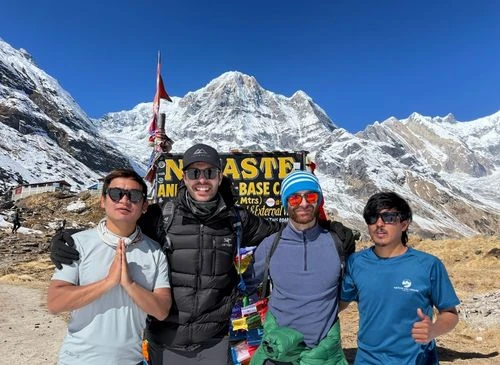
trekkers on abc
In Hindu culture, Annapurna is the Goddess of Food and Nourishment. She is often shown holding a golden bowl of rice and a ladle, symbolizing her role in feeding the world. Local legends tell us that she is an avatar of Parvati, the wife of Lord Shiva. You can find that the mountain is treated with great respect because locals believe the goddess resides there. Many local communities you meet along the trails inhabit the lower slopes and valleys, and follow a terraced farming way for agriculture
The spiritual image of the mountain influences how you travel through the region today. Many local communities, such as the Gurungs and Magars, perform rituals to honor the mountain before planting their crops. They see the melting snow as a gift that turns into rivers, watering their terraced farms. When you trek through these high valleys, you will encounter small shrines and prayer flags that reflect this ancient bond. The mountain is seen as a mother figure who provides plenty, making it one of the most sacred landscapes in the entire Himalayan range.
Popular Treks That Take You to Annapurna
The Annapurna region is famous for a wide network of trekking routes that connect villages, valleys, and high passes. It is a vast playground for hikers. It offers everything from short walks through green hills to long journeys over high mountain passes. Each trail provides a different perspective of the massive peaks like Annapurna South, I, Machhapuchhre, Gangapurna, etc. that dominate the horizon. Whether you want to see the local culture in stone villages or stand at the foot of an 8,000 m peak, there is a route here for you.
Annapurna Base Camp (Sanctuary) Trek
The Annapurna Base Camp Trek leads you into a natural rock basin known as the Annapurna Sanctuary. You walk through various landscapes: starting from low terraced fields and moving into dense bamboo and rhododendron forests. You will see massive peaks like Annapurna South and Machhapuchhre from very close distances as your trail climbs to 4,130 m. The route is famous for its stone stairs and the warm hospitality in the Gurung villages. You can enjoy the natural hot springs at Jhinu Danda on your way back to relax your muscles. You get a safe and steady climb to help your body adjust to the higher altitude.
Plan Your Trek Your Way
Choose your preferred route, duration, travel dates, and trekking style to create an Annapurna Circuit experience that fits you.
The Annapurna Circuit Trek is a classic journey that circles the entire Annapurna Massif. On this trek, you will experience a changing world where the landscape shifts from lush green subtropical forests to a dry, high-altitude desert that resembles the Tibetan Plateau. You will see the many faces of the range, including the massive south face of Annapurna and the sharp peaks of the Nilgiri and Dhaulagiri mountains.
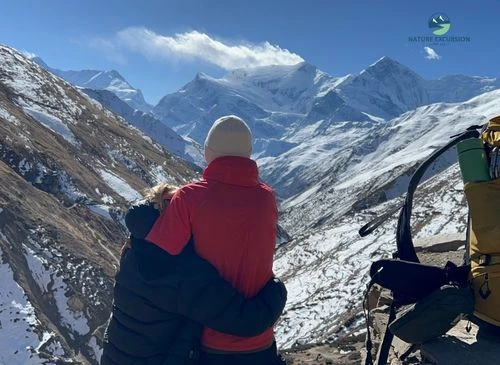
Crossing the Thorong La Pass at 5,416 m is the highlight of the trip, giving you a sense of achievement as you look out over the vast Mustang valley and the deep Kali Gandaki gorge. The Annapurna Circuit Trek is suitable for a wide range of people, from beginners with good fitness to experienced trekkers. At Nature Excursion, we have designed the route with plenty of time to acclimatize to the thin air, making it safer for those new to high-altitude walking.
Poon Hill / Ghorepani Trek
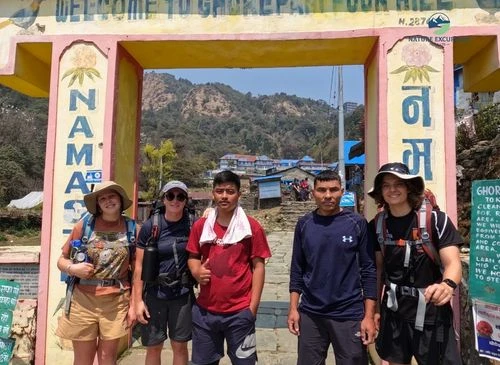
The Ghorepani Poon Hill Trek offers some of the most famous mountain views in Nepal without requiring weeks of travel. As we walk through the lower Gurung villages like Ulleri and Bhanthanti, the massive peaks of Annapurna South and Machhapuchhre appear through gaps in the rhododendron trees.
trekkers on Poon Hill view point
The highlight of our journey is the early morning climb to the top of Poon Hill at 3,210 m. This area is suitable for almost anyone with a basic level of fitness, making it a top choice for families and first-time hikers.
Mardi Himal Trek
The Mardi Himal Trek is a hidden path that stays on a high ridge rather than dropping into deep river valleys. You will walk through ancient forests of oak and rhododendron where the ground is covered in soft moss, and the air is cool. As you climb higher, the trees disappear, and the terrain becomes a rugged, grassy ridge with views of the Annapurna South and Hiunchuli peaks.
The most famous sight is the "Fish Tail" mountain, Machhapuchhre, which stands so close to the trail that you can see every detail of its icy face. We recommend it for beginners who have a good level of fitness, as the trail involves some steep climbing on narrow ridge paths.
How to Reach Annapurna from Kathmandu and Pokhara
To reach the Annapurna region, you must first travel from Kathmandu to Pokhara, which is the main gateway for most treks. You can choose between a quick 25-minute flight or a longer ground journey of about 200 km. Flights depart daily from Tribhuvan International Airport and offer a fast way to start your adventure. If you prefer the road, you can take a tourist bus, which usually takes 8 to 12 hours depending on traffic and road conditions.
For greater comfort and flexibility, at Nature Excursion, we can arrange a private vehicle or a jeep, which typically cuts travel time to about 7 hours. Once you arrive in Pokhara, the journey to the actual trailheads depends on your specific trek. For popular routes like the Annapurna Base Camp or Ghorepani Poon Hill, we drive about 2 hours to Nayapul or Kande. If you are heading for the Annapurna Circuit, the journey starts further east.
You will need to travel from either Kathmandu or Pokhara to Besisahar, and often continue by local jeep to Dharapani to begin walking. Before you lace up your boots, we ensure all legal requirements are met. You will need the Annapurna Conservation Area Permit (ACAP) and the Trekkers' Information Management System (TIMS) card to enter the region.
Have Questions About Your Trek?
Get quick answers about routes, costs, permits, difficulty, or travel dates from our trekking team before you book.
Mount Annapurna is located in the north-central Gandaki Province of Nepal, sitting approximately 160 km northwest of Kathmandu and just north of the city of Pokhara. As a major hub for global tourism, this massif contains Annapurna I Main, which is the highest peak in the range at 8,091 m.
Despite its popularity, the Annapurna region has recorded several fatalities each year, mostly due to altitude sickness and storms, so safe planning and turnaround decisions are essential. Whether you are looking for a short hike or a challenging climb, we invite you to explore these sacred peaks with us to experience the best of the Himalayas.
Written by
Raju GurungMD
Gurung is the founder and managing director of ‘Nature Excursion Pvt. Ltd.’ The mountains and hills from his village, Rubi Valley, always had him wondering, and he became one of the travel enthusiasts from his early childhood.
Mount Annapurna I is 8,091 m (26,545 ft) above sea level, the 10th-highest mountain in the world. Located in north-central Nepal within the Annapurna...
As of June 2026, exactly 572 climbers have successfully reached the summit of Annapurna I. This updated figure comes directly from Nepal's Department...
How far do you actually have to walk to complete the legendary Annapurna Circuit? The total Annapurna Circuit Trek distance usually spans between 160...


.jpg)


.jpg)

.webp)



.webp)
.webp)