Where Is Deurali Located on the ABC Route
Deurali sits at about 3,230 m in the Modi Khola valley along the Annapurna Base Camp Trek route, inside the Annapurna Conservation Area. It lies between the Himalaya (2,900 m) below and Machhapuchhre Base Camp (3,700 m) above. It is the last main stop before the trail climbs toward Machhapuchhre Base Camp and eventually Annapurna Base Camp (4,130 m). Trekkers rest here, recover from the day’s walk, and prepare for the journey ahead.

Geographically, Deurali lies within a glacial corridor carved by the Modi Khola River, which flows from the Annapurna Sanctuary. This stretch of the trail is also known for being sensitive to avalanches (something many guides emphasize but few blogs explain clearly), particularly during early spring.
Need Help Planning?
Confused about the Deurali to Annapurna Base Camp route? Talk with our trekking experts and get practical advice for your journey.
Distance from Deurali to Annapurna Base Camp
The distance from Deurali (3,230 m) to Annapurna Base Camp (4,130 m), passing through Machhapuchhre Base Camp, is roughly 8–9 km. The exact distance depends on which lodges you stop at and how the route is measured. Most trekkers take 4–6 hours to complete this stretch. This Deurali to ABC distance doesn’t look intimidating, but the altitude gain, weather shifts, and how quickly the landscape transforms make every kilometre count.
Route breakdown:
- Deurali → Machhapuchhre Base Camp (MBC): About 4 km, 2–2.5 hours of steady uphill walking.
- MBC → Annapurna Base Camp: Another 4–5 km, usually 2–3 hours depending on your pace and how often you stop for photos (which, honestly, is a lot).
It took me 5 hours to get to Annapurna Base Camp. I walked at what I would call a Sanctuary Pace, steady, unhurried, but mindful of the cold mountain wind. The elevation gain was around 900 m. In a single day, I moved from a narrow river valley to a massive glacial amphitheater surrounded by 7,000 and 8,000 m peaks.
What the Trail Looks Like After Deurali
Leaving Deurali early in the morning, I immediately sensed a shift in the world around me. The lush forests and greenery from lower elevations were gone. In their place stood a raw, high-altitude landscape shaped by rock, wind, and ice. As I walked along the Modi Khola valley, my headlamp lit up a trail that climbed gently through a narrowing gorge. Below, a cold glacial river rushed past, its sound echoing through the valley.
The colors of the trek changed dramatically, too. The bright greens of rhododendron forests faded into shades of grey stone, brown grass, and scattered alpine shrubs. Slowly, the tight V-shaped gorge opened into a wide U-shaped glacial basin. At that moment, it felt less like I was walking toward the mountains and more like I was walking inside them, surrounded by cliffs, hanging icefalls, and massive rock walls.

The trail conditions also felt noticeably better than I had read in older guides. Steeper parts now have stone steps, and retaining walls support sections that used to feel fragile. Some stretches still felt narrow and a bit exposed, but the path was much clearer overall. With fresh trail markings and better signs, I felt more confident moving forward, even when clouds slowly rolled through the valley.
Still, the mountains constantly reminded me where I was. I crossed rocky sections, loose scree, and old avalanche debris. Despite the improved trail, this part of the trek remained wild, dramatic, and deeply humbling.
Here’s one tip I would like to give you. If you trek in late February or early March, it will be cold, but not as bone-chilling as it is in December or January. You still need to layer up in thick, warm clothes. However, the real challenge lies in the ground. As winter snow begins to melt and settle, the uphill climbs and downhill descents become very slippery. You must wear waterproof shoes so the melting snow doesn’t soak your feet. Most importantly, you need to use crampons (microspikes) for grip and gaiters to keep snow out of your boots. While the trail is wider and improved, these gear items are essential to stay safe on the icy slopes.
Walking from Deurali to Machhapuchhre Base Camp
I left Deurali at 6:30 AM after breakfast. The first part of my walk from Deurali to Machhapuchhre Base Camp felt easier than I expected. The path followed the river across flat, rocky ground, with a few short uphill sections. I crossed several small wooden and metal bridges. And with the recent trail improvements, everything felt more stable and safe compared to the old, shaky crossings many trekkers mention.
As I climbed higher toward 3,700 m, the scenery slowly changed. The trees began to disappear, leaving behind only low shrubs and grey stones. Near the famous Hinku overhanging rock, the valley felt wide, open, and truly alpine. This section once had a reputation for being narrow and exposed, but stone steps and side walls now make it feel much more secure, even though you can still sense the steep drop and hear the rushing river below.

After crossing the Hinku rock, the trail entered the avalanche-prone area. This part requires extra awareness, especially in early spring. Warmer daytime temperatures can loosen snow and rocks from the slopes above. My guide led us along the left side of the valley to stay farther from the steep walls. I made sure to stay alert, looking up and around, and I moved quickly through this section without stopping for breaks.
After about two to two and a half hours of calm, steady walking, the lodges of Machhapuchhre Base Camp finally appeared ahead. I sat down for a cup of hot ginger lemon honey tea and rested for about 45 minutes. The break helped me recover, adjust to the thinner air, and prepare for the final walk into the landmark known as the Annapurna Sanctuary.
By the time I reached MBC:
- Trees were completely gone
- Only alpine shrubs remained
- The temperature had dropped significantly
Machhapuchhre Base Camp to Annapurna Base Camp
When I left MBC, the whole feeling of the trip changed. The sun was fully up, and the air started to feel a bit warmer as I turned west. I was now walking on the wide floor of the Annapurna Sanctuary. To my left, the river stayed low in the valley, while in front of me, the huge mountain walls began to curve around like a giant bowl. Even though the thin air made me move slowly, the ground felt solid and safe under my boots.
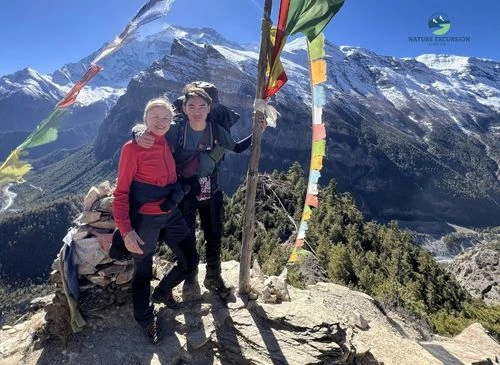
The last 1.5 hours of the walk were very special. My group stopped talking because we were so amazed by the view. With every step, Annapurna I (8,091 m) and Hiunchuli (6,441 m) looked bigger and more powerful. The ground grew flat, and the snowfields widened. I had Annapurna South and Gangapurna on my sides, with the famous Machhapuchhre mountain standing behind me.
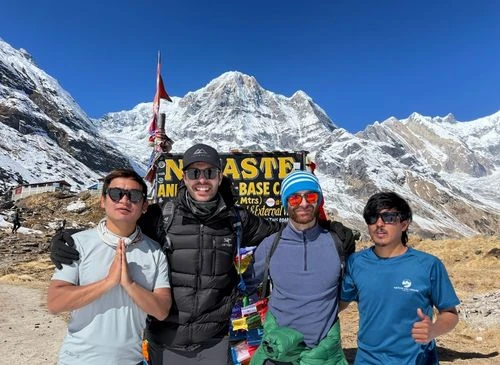
I reached the famous Annapurna Base Camp sign around 1:00 PM. I spent some time taking photos at the board. Then walked the last few meters to the teahouse where I would be staying overnight.
Weather Conditions Between Deurali and ABC
Between Deurali and ABC, the weather conditions shape your whole day. Here’s what I experienced and what the 2026 updates show for Annnapurna Treks:
- Temperature: In peak seasons (October-November and March-April), early mornings leaving Deurali can feel around 0 to -5°C. Above MBC, it can get even colder on windy days. At ABC, pre‑sunrise temperatures often drop to -5 to -10°C, especially in late autumn and late winter.
- Wind condition: The Sanctuary acts like a bowl that funnels wind in the afternoon. Calm, sunny mornings can quickly turn into gusty, cloudy afternoons, which is why most groups now aim to reach ABC by late morning.
- Snow and trail conditions: There can be snow patches between Deurali and MBC in late winter and early spring, with more consistent snow above MBC. Further, after the heavy monsoon, some trails may have been washed away.
- Monsoon caveat: Some blogs skip this, but from June to August, the Deurali to Annapurna Base Camp section can be dangerous. The danger is shaped by slippery stone steps, low visibility, landslide risk, and leeches at lower elevations. Local trek guides strongly advise avoiding ABC during peak monsoon unless you are experienced and flexible.
Key 2026 weather insights:
- Snowfall patterns have been less predictable.
- Late spring storms (April–May) have increased slightly in recent years.
- Afternoon clouds often build quickly inside the Sanctuary.
Plan Your Trek Your Way
Choose your preferred route, duration, travel dates, and trekking style to create an Annapurna experience that fits you.
Mountain Views Along the Way
From Deurali onward, the mountains stop being just the view and become the world around you. I had seen hundreds of photos of ABC before the trek, but none of them captured how close the peaks actually feel when you’re standing there.
Here are the giants I met along the path:
- Machhapuchhre (Fishtail, 6,993 m): Between Deurali and MBC, it dominates the skyline. At first, I could only see hints of it behind ridges, but soon it rose sharply ahead, its twin peaks impossible to miss.
- Hiunchuli (6,441 m) and Annapurna South (7,219 m): Past MBC, as I move toward ABC, these peaks towered to my left, forming a solid wall of snow and rock.
- Annapurna I (8,091 m): When I finally reached base camp, Annapurna I felt very close. I could see every fractured ice wall, the hanging seracs, and even the avalanche paths with my own eyes.
- Gangapurna (7,455 m), Tent Peak (5,663 m), and the surrounding bowl: Standing in the center of ABC and turning slowly, I was surrounded on three sides by Gangapurna, Tent Peak (Tharpu Chuli), Annapurna III, and the ridges that make the Sanctuary feel enclosed. At sunrise, the Annapurna mountain glows golden, and the light slowly slides down its face. If you wake up at 5:30 AM and step outside before breakfast, you’ll understand exactly what I mean.
Accommodation Options Between Deurali and ABC
There are about 5 or 6 teahouses at each stop between Deurali and Annapurna Base Camp. These teahouses don’t have the fancy features of big hotels, but they are safe, clean, and provide everything needed to stay healthy during the trek. That said, these houses provide purified drinking water and hot tea. Since the area is sacred beyond Sinuwa, no non-vegetarian menus are served; vegetarian meals are standard.
Electricity comes from solar panels, so charging devices is only possible when the sun is out. Carrying a power bank is a lifesaver here. Some lodges will offer Wi-Fi, but it usually costs extra. Further, don’t expect heated beds or reliable hot showers. The rooms are simple but far more comfortable than camping in a tent.
Here is the list of available teahouses in Deurali, Machhapuchhre Base Camp, and Annapurna Base Camp with contact info:
At Deurali:
Hotel Name | Phone Number |
New Panorama Guest House | 9846257775, 9851196854 |
Dream Lodge & Restaurant | 9863500218, 9846287693 |
Shangrila Guest House | 9862385328, 9840679043 |
Hotel View Point Deurali | 9746304090, 9846359832 |
Deurali Guest House | 9846280870, 9866050425 |
At Machhapuchhre Base Camp (MBC):
Hotel Name | Phone Number |
Fishtail Guest House | 9856069055, 9856035086 |
Shankar Guest House | 9745457948, 9866343291 |
Gurung Co-Operative | 9749359058, 9749359056 |
Machhapuchhre Guest House | 9745289937, 9762868430 |
Gangapurna View Lodge | 9846214351, 9745449332 |
At Annapurna Base Camp (ABC):
Hotel Name | Phone Number |
Annapurna Guest House | 9846063557, 9844920552 |
Annapurna Sanctuary Lodge | 9845397742, 9846923397 |
Snowland Lodge | 9806729709, 9817127508 |
Hotel Paradise Garden | 9846605439, 9869141256 |
Sunrise Guest House | 9869093628, 9866099316 |
Hotel Peaceful | 9864381912, 9840604468 |
Why Deurali to ABC Is the Most Memorable Part of the Annapurna Base Camp Trek
For me, the walk from Deurali to ABC was the moment the trek to Annapurna Base Camp stopped feeling like just a famous route and started feeling like my own story. It’s the day when effort, altitude, and scenery all come together in one long, unforgettable walk.
So much changes in a single day. The morning begins in darkness. I left Deurali wrapped in layers, headlamp glowing, breath visible in the cold air. The trail was quiet, and every step felt slow but steady. By the time I reached Machhapuchhre Base Camp, the world looked completely different. The sun had started to rise, painting the snowy peaks with soft pink light. Fatigue was still there, but the views made it easier to keep moving.

Then came the Sanctuary. As I walked the final stretch toward Annapurna Base Camp, everything felt calmer, almost silent. The valley opened wide and the Annapurna massif rose like walls around me. And finally, the finish. At the heart of the Annapurna Base Camp, mountains surrounded me completely.
What made this section even more special were the people. Along the climb, I watched strangers slowly become a team. We encouraged each other on steep sections, shared snacks, and celebrated little progress. By the time we arrived, we were a small group that had earned the experience together. The best moment happened the next morning at sunrise. Standing outside in the freezing sunrise air, I watched the first light touch the face of Annapurna I. Watching this, I finally understood why so many trekkers return again and again for trekking in Nepal.
Have Questions About Your Trek?
Get quick answers about routes, costs, permits, difficulty, or travel dates from our trekking team before you book.
Final Thoughts: Should You Be Prepared?
Yes, absolutely. The walk from Deurali to Annapurna Base Camp is not technically complex. But this section falls under the most demanding sections of the trek. This section demands proper acclimatization, early starts, warm layers, microspikes in colder months, and awareness of avalanche-prone areas.
Proper acclimatization helps the body cope with the thinner air and reduces the risk of altitude sickness. Early starts give clearer skies and safer walking conditions. Warm layers protect from biting morning cold and sudden wind. In colder months, microspikes can make the difference between confident footing and a stressful, slippery climb. And perhaps most importantly, understanding avalanche-prone areas helps with safer decision-making.


.webp)