Everest Base Camp Helicopter Tour Price at a Glance
| Tour type | Typical 2026 price | Group size | Best for |
|---|
| Shared group flight | USD 1,250 to 1,300 per person | 4 to 5 passengers | Solo travelers, couples, and anyone without a full group |
| Private charter | USD 5,100 to 6,500 per helicopter | 1 to 5 passengers | Families, photographers, and anyone who wants a set time |
| Private, split 5 ways | About USD 1,020 to 1,300 per person | 5 people you know | Groups who want privacy at close to the shared rate |
| Shorter flight from Lukla or Gorakshep | About USD 600 to 1,000 per person shared | 2 to 5 | Trekkers already in the Khumbu who want a fly-out |
The average cost of a full Kathmandu round-trip helicopter tour to Everest Base Camp is around USD 1,250 to 1,500 per person if you join a group. A private charter is a different product because you pay for the aircraft, not a single seat.
What Is the Everest Base Camp Helicopter Tour?
The Everest Base Camp helicopter tour is a same-day round-trip flight from Kathmandu’s domestic terminal into the Khumbu region. It is not a trek. Most EBC heli tours use an Airbus H125 (also called the AS350 B3), a high-altitude helicopter certified for mountain flying in Nepal.

The usual route is Kathmandu to Lukla for a short fuel stop at Tenzing-Hillary Airport, then up the Dudh Koshi valley past Namche Bazaar, Tengboche Monastery, the Khumbu Glacier, and an overflight of Everest Base Camp. The two ground stops are Kala Patthar (5,545 m) for mountain views and Hotel Everest View at Syangboche (3,880 m) for breakfast and closer views of Everest, Lhotse, and Ama Dablam. You are back to Kathmandu by late morning or midday on a clear day.
Who is this Everest Helicopter Tour Designed For?
This tour suits travelers with only one free day in Kathmandu, older visitors, anyone who cannot do long days of walking, luxury travelers who prefer comfort over trekking to EBC, aerial photographers and nature lovers, and climbers who want a first look at Everest before an expedition. It also fits trekkers who want ahelicopter return after walking up to Everest Base Camp.
Start fromUSD 3000USD 2783based on 3 reviews
Everest Base Camp Helicopter Tour Cost in 2026
A shared Everest Base Camp helicopter tour in 2026 costs USD 1,250 to 1,300 per person. A private charter costs USD 5,100 to 6,500 for the full helicopter, regardless of how many seats you fill (up to five). Across Nepal, published shared rates usually sit between USD 1,200 and 1,500. The main difference in price is between shared and private tours, not hidden extras from one company.
Note: All figures here include 13% VAT. Peak-season fuel surcharges can still add a little. Ask for the final number in writing before you pay a deposit.
Shared Group Helicopter Tour Price
A shared helicopter tour to Everest Base Camp means you take one seat on a helicopter that can carry up to five passengers plus the pilot. You fly with other travelers you have not met. Each person pays their own fare. The 2026 shared EBC helicopter rate is USD 1,250 to 1,300 per person.
The departure time is a fixed morning slot. The route is the standard one, not a custom loop. This is the option most solo travelers and couples choose. If five paying passengers fill the aircraft, the per-person cost is close to the bottom end of a private charter split five ways. However, you still follow the shared timetable.
Private Charter Helicopter Price
A private helicopter flight to Everest Base Camp costs USD 5,100 to 6,500 for the whole helicopter. You pay that total whether one person or five people fly. The value shows up when you split it.
| Passengers on a private charter | Approx. cost per person (from USD 5,100) | Approx. cost per person (up to USD 6,500) |
|---|
| 1 (solo) | USD 5,100 | USD 6,500 |
| 2 | USD 2,550 | USD 3,250 |
| 3 | USD 1,700 | USD 2,167 |
| 4 | USD 1,275 | USD 1,625 |
| 5 | USD 1,020 | USD 1,300 |
With a private charter, you set the morning time (within safe flying hours), can linger a little longer on the ground if weather allows, and don't have to wait for other bookings to fill the helicopter.
Families, honeymoon couples, and photographers who need cabin space for cameras usually prefer this private helicopter option. Likewise, a group of four or five friends who book together also get private timing at a per-person cost close to the shared rate. That is the cleanest way to get both privacy and a fair price.
Shared vs Private Helicopter Tour Price Comparison
| Tour type | Group size | Price per person (USD, 2026) | Full helicopter price (USD) | Schedule |
|---|
| Shared / group tour | 4 to 5 mixed travelers | 1,250 to 1,300 | Split among the group | Fixed morning, set route |
| Private, 1 passenger | 1 | 5,100 to 6,500 | 5,100 to 6,500 | Flexible |
| Private, 2 passengers | 2 | 2,550 to 3,250 | 5,100 to 6,500 | Flexible |
| Private, 3 passengers | 3 | 1,700 to 2,167 | 5,100 to 6,500 | Flexible |
| Private, 4 passengers | 4 | 1,275 to 1,625 | 5,100 to 6,500 | Flexible |
| Private, 5 passengers | 5 | 1,020 to 1,300 | 5,100 to 6,500 | Flexible |
So, is it cheaper to book private or join a group? For one or two people, a shared seat is cheaper. For four or five people traveling together, private is often the better buy because you pay a similar amount per person and you control the schedule.
What Determines the Price of an Everest Helicopter Tour?
The helicopter costs roughly the same to operate with one passenger or five. That is why a solo private quote looks high, and a full shared flight looks fair.
Other factors that affect the price include:
- Landing height: A landing at Kala Patthar (5,545 m) needs more fuel, a weight shuttle, and a better weather window than a flyover that only stops at Hotel Everest View.
- Season: Spring and autumn are the busiest and most reliable. Monsoon season often has more empty seats but also more cancellations.
- Group weight: Above about 4,200 m, the Airbus H125 cannot lift a full cabin. Extra shuttle legs may be needed, which can add time but should not add a surprise fee if you declared weights at booking.
- What is bundled: Hotel transfers, oxygen, VAT, and breakfast are not always included in the headline fare.
- Operator standard: Civil Aviation Authority of Nepal (CAAN) mountain-rated pilots and a maintained H125 cost more than a vague “mountain flight” with no aircraft named.
Note: If a quote is far below USD 1,200 for a Kathmandu round trip with a Kala Patthar landing, ask what is missing. Landing fees, breakfast, transfers, or permits are the usual gaps.
What Is Included in the Everest Base Camp Helicopter Tour Price?
Here's what the EBC helicopter tour price covers:
- Round-trip helicopter from Kathmandu domestic terminal into the Everest region and back
- Fuel stop at Lukla (Tenzing-Hillary Airport)
- Low overflight of Everest Base Camp and the Khumbu Glacier
- Short landing at the Kala Patthar helipad (5,545 m) when weather and weight allow
- Landing and rest time at Hotel Everest View (3,880 m)
- Emergency oxygen on board
- CAAN-certified high-altitude mountain pilot
- Hotel pickup and drop-off in Kathmandu (confirm this line)
- 13% Nepal VAT
- Aviation liability cover on the flight
What Is Not Included in the Everest Base Camp Helicopter Tour Price?
| Extra | Usually in the tour price? | Typical 2026 cost | Notes |
|---|
| Sagarmatha National Park entry permit | Often no | About NPR 3,000 (around USD 23) | Needed for a landing inside the park. |
| Khumbu Pasang Lhamu Rural Municipality fee | Often no | About NPR 3,000 (around USD 23) | Local entry fee. TIMS is not used on the standard Khumbu route. |
| Breakfast at Hotel Everest View | Often no | About NPR 4,000 (around USD 30 to 40) | Pay on the day at Syangboche. |
| Travel insurance | No | Varies by policy | Cover helicopter evacuation to at least 6,000 m. |
| Tips for pilot and ground crew | No | Your choice | Customary, not required. |
| Extra meals, drinks, souvenirs | No | As you spend | Kathmandu meals before and after the flight are on you. |
| Overweight bag surcharge | No | If payload is over the limit | Declare cameras and bags when you book. |
| Drone permit in Sagarmatha National Park | No | Arranged in advance | Do not assume you can fly a drone on the day. |
| Weather delay hotel night in Kathmandu | No | One extra night | Keep a buffer day. |
| Emergency rescue (medical) | No (insurance) | Thousands of USD if uninsured | The tour oxygen is for short altitude exposure, not a rescue policy. |
Budget about USD 75 to 90 per person on top of the headline fare if permits and breakfast are billed separately. Sagarmatha National Park permit fees are set by the authorities, not by the helicopter company.
Explore the Everest Region
Explore our other Everest packages and find a trip that matches your preferred experience, itinerary, duration, and budget.
Where Does the Helicopter Actually Land During the Tour?
The helicopter does not land at Everest Base Camp. It overflies the camp at about 5,364 m, then lands at Kala Patthar (5,545 m) for 10 to 15 minutes and at Hotel Everest View (3,880 m) for 40 to 60 minutes, weather and weight allowing.
That is the part most websites skip. The tour name uses “Everest Base Camp.” The skids go down on rock and a hotel helipad, not on the glacier.
Kala Patthar Helipad (5,545 m)
This is the high point of the day. You step out for 10 to 15 minutes. Thin air, wind, and engine limits keep the stop short.
Kala Patthar sits on a ridge above Gorakshep. From here you see Everest’s South Face without the Nuptse wall blocking the summit, which is why the view is clearer than from base camp itself. Morning light on the face is the best window for photos. Read more on why Kala Patthar gives the clearest view of Everest.
Landing is not a promise in writing for every single day. Cloud, wind, or a heavy passenger load can turn the stop into an overflight. The pilot decides on the day.
Hotel Everest View (3,880 m)
The helicopter lands at Syangboche, above Namche Bazaar, at Hotel Everest View, often called the world’s highest hotel with a view restaurant. You stay 40 to 60 minutes. This is the recovery stop after Kala Patthar. Ama Dablam, Thamserku, and Kangtega sit across the valley.
Breakfast is usually extra (about NPR 4,000). Some operators reverse the order of the two landings if the high helipad is socked in. For the area around the hotel, see Hotel Everest View and the Syangboche area.
Why the Helicopter Cannot Land at Everest Base Camp
There are two practical reasons. The first reason is that Everest Base Camp sits on the moving Khumbu Glacier. There is no stable tourist helipad among tents, ladders, and crevasse terrain. The second reason is that park and aviation rules restrict tourist landings on that glacier surface. The aircraft flies a low orbit for photos, then climbs to Kala Patthar. That is the safe, legal version of the tour. It is also the better viewpoint. For how high helicopters can actually go near Everest, read helicopter altitude limits above Everest.
The Full Day Everest Base Camp Heli Tour Itinerary: From Kathmandu and Back
Step 1. Hotel pickup (5:00 to 6:00 AM)
A private vehicle picks you up from your Kathmandu hotel and takes you to the domestic terminal. Morning air is calmer. Clouds and wind build later. Be at the terminal by about 6:30 AM for weighing, a short safety talk, and boarding.
Step 2. Departure from Kathmandu (6:30 to 7:30 AM)
Takeoff is from about 1,400 m. The flight heads northeast over the hills. Lukla is roughly 30 to 40 minutes away.
Step 3. Refueling at Lukla (around 8:00 to 8:30 AM)
You land at Tenzing-Hillary Airport (2,860 m) for 10 to 15 minutes of fuel. Passengers stay near the terminal. The H125 needs this stop to keep weight and fuel in a safe range for the high sector. It is not a sightseeing halt.
Step 4. Khumbu overflight and Everest Base Camp (around 8:30 to 9:15 AM)
From Lukla, the helicopter follows the valley past Namche Bazaar and Tengboche, then over the Khumbu Glacier and a low pass of Everest Base Camp and the Khumbu Icefall. Keep the camera ready. A shutter speed of 1/1000s or faster helps with vibration.
Step 5. Kala Patthar landing (10 to 15 minutes)
This is the ground stop at 5,545 m. Spring temperatures often sit around -5 to -15°C. Winter can reach -20 to -30°C. Wear a down jacket, gloves, and a hat in every season. Oxygen is on the helicopter if you feel light-headed on the way down.
If the group is heavy, the pilot may shuttle two or three people at a time from Pheriche. That can add 30 to 60 minutes. It is normal high-altitude practice, not a fault in your booking.
Step 6. Hotel Everest View (40 to 60 minutes)
You drop to 3,880 m, eat if you want, and photograph Ama Dablam from the terrace. Most guests remember this stop as the calm part of the morning.
Step 7. Return to Kathmandu (about 10:30 to 11:30 AM)
You may fuel again at Lukla. Hotel drop-off follows. Plan on 4 to 5 hours door to door. Do not book an international flight the same afternoon. Weather can push the whole morning later.
Weight Limits and How Passenger Weight Affects the Tour
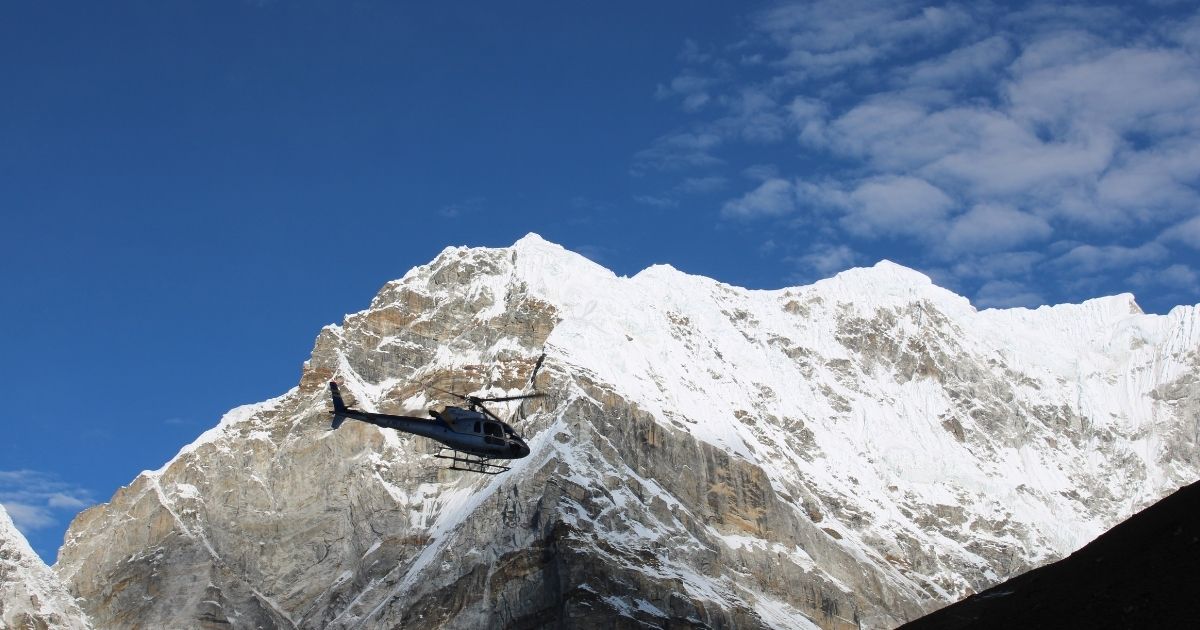
Weight limits affect the Everest helicopter tour price because they decide how many people can go to Kala Patthar in one lift. They rarely change the published seat rate. But they can change how the morning runs.
- Maximum passenger capacity: The Airbus H125 takes up to five passengers plus the pilot on the Kathmandu to Lukla leg. Above about 4,200 m, thinner air cuts lift. So, combined passenger weight on the high shuttle is often kept around 250 to 300 kg, which usually means two or three people at a time to Kala Patthar. If a group of four or five is over that mark, some people wait at Lukla or Pheriche for the next rotation. There should be no extra charge when you declared weights up front.
- Camera gear and luggage: Bring one small daypack, about 5 kg. Large tripods, drone cases, and cinema kits need a private charter so the payload is planned. Spare batteries and memory cards stay in the cabin bag.
What to Expect at the Weight Check
Shared-tour passengers are often weighed with their bags. It is an aviation check, not a judgment. Tell the operator your approximate body weight when you book. Build 45 to 60 minutes of slack into a shared-day plan in case of a shuttle.
Departure Points: Kathmandu Round Trip vs a Shorter Flight from Lukla
You can start your Everest helicopter tour either from Kathmandu or from inside the Khumbu region. The choice affects the price, flight time, and how much of the journey you spend in the air versus on the ground.
Full EBC Round Trip from Kathmandu
This is the classic Everest helicopter experience. You start and end your day in Kathmandu, with the whole Khumbu region unfolding beneath you in one morning. Shared flight costs USD 1,250 to 1,300 per person, and private charter costs USD 5,100 to 6,500 per helicopter
This option works best if you are based in Kathmandu, have only one free day, and want to see Everest, the Khumbu Glacier, and the high valleys without spending two weeks on the Everest Base Camp Trek trail.
Helicopter Tour from Lukla
Instead of Kathmandu, you can also depart from Lukla. Also, starting from Lukla saves you money because a shorter scenic sector costs less than a full Kathmandu round trip, since you skip the long first leg. Shared fares from the Khumbu usually sit around USD 600 to 1,000 per person, depending on the exact pickup point and route.
This is a popular choice for trekkers who flew into Lukla and want a half-day Everest view flight, and groups combining trekking with a helicopter return.
Furthermore, trekkers who have already walked to Gorakshep often take a helicopter exit from Gorakshep to Lukla instead of walking down for three or four days. You can also combine the full EBC trek with a helicopter return flight, or choose EBC via Gokyo Lakes with a helicopter exit.
A one-way from Gorakshep all the way to Kathmandu is possible on a private Everest Base Camp helicopter. It costs more than a hop to Lukla because the aircraft has to cover the full distance and may still need a fuel stop.
EBC Helicopter Tour vs Full EBC Trek
EBC helicopter tour and EBC trek are two very different ways to experience Everest. One is a morning in the air. The other is two weeks of walking, teahouse nights, and steady altitude gain. The cost per person can look similar, but the time, effort, and experience are not.
Quick comparison:
| Factor | Helicopter tour | Full EBC trek (12 to 14 days) |
|---|
| Duration | 4 to 5 hours, same-day return | 12 to 14 days from Kathmandu |
| Cost per person | USD 1,250 to 1,300 shared, or USD 5,100+ private | About USD 1,200 to 2,500+ guided, all-inclusive |
| Physical demand | None. You sit in the aircraft. | High. 5 to 8 hours of walking most days |
| Maximum altitude | 5,545 m at Kala Patthar | 5,545 m at Kala Patthar on foot |
| Acclimatization | None. You return to Kathmandu the same day | Built into the itinerary with rest days |
| Altitude sickness risk | Low for most people (short exposure, oxygen on board) | Moderate to high without proper rest days |
| Permits | Sagarmatha NP and usually Khumbu municipality fees | Same two permits. TIMS is not used on the standard Khumbu trek |
| Culture | Short stops only | Villages, monasteries, teahouses |
| Photos | Aerial views plus a brief ridge landing | Trail, villages, and sunrise from Kala Patthar |
| Best for | Short trips, limited mobility, luxury, aerial photos | People who want the walk and the culture |
| Weather risk | Higher. One morning window | Lower. A multi-day plan can absorb a delay |
| Sleep | Your Kathmandu hotel | Teahouses on the trail |
For a line-by-line trek budget, see the full Everest Base Camp trek cost breakdown. The altitude profile of the Everest region shows why the walk needs rest days, and the flight does not.
Who Should Choose the Helicopter Tour
Pick the flight if you have one or two days in Kathmandu and still want Everest. Pick it if long days of walking are not realistic. Pick it if you want a comfortable, high view without teahouse nights. Pick it if aerial photos are your main goals. Pick it as a fly-out after you have already trekked. Luxury travelers who want lodges plus a scenic flight often look at the luxury EBC trek package.
Who Should Do the Full EBC Trek
Do the full trek if you care about Sherpa villages, monasteries, and the feeling of arriving on foot. Also choose the trek over a heli tour if you want time to absorb the landscape and culture, and are happy to spend two weeks in the mountains. The helicopter cannot copy that. If two weeks is too long, the shorter EBC trek option cuts days but still uses the classic EBC trek trail. How demanding the full EBC trek is on the body is worth reading before you decide.
Plan Your Own Adventure
Want more than a helicopter tour? Build a Nepal trip around your preferred destinations, dates, itinerary, and travel style.
Best Time for the Everest Base Camp Helicopter Tour
The best months for a clear view are October, then April and early November, and often May mornings before the cloud builds. Spring (March to May) and autumn (September to November) have the most reliable flying weather. For a wider seasonal picture, read the complete guide to the best time for Everest.
| Season | Months | Visibility | Weather | Flight reliability | Recommendation |
|---|
| Spring | March to May | Very good, some haze in late May | Stable mornings, milder cold at Kala Patthar | High | Best overall. Book 3 to 4 months ahead. See spring conditions on the Everest route. |
| Autumn | September to November | Sharpest of the year after monsoon | Clear, colder in November | Highest in October | Best for photography. October fills fast. See the autumn Everest season. |
| Winter | December to February | Excellent on clear days | Very cold at 5,545 m (-20 to -30°C) | Moderate. Snow can delay | Fine if you have a serious down jacket and a buffer day. |
| Monsoon | June to August | Poor to mixed. Cloud sits in the valleys | Rain, afternoon build-up | Lowest | Avoid if your Nepal trip is short. |
Helicopter fares do not drop much in winter. Availability does. Monsoon discounts are not worth a canceled morning if you fly home the next day.
Photography Tips for the EBC Helicopter Tour
- Ask before the flight whether any window can open. Many H125 tours shoot through glass.
- Wipe the pane clean. Use a wide lens (16 to 35 mm) for valleys and a short telephoto (70 to 200 mm) for Everest’s face.
- Set shutter speed to 1/1000s or faster.
- Tripods are useless in the cabin, so use image stabilization.
- The best light at Kala Patthar is about 30 to 45 minutes after local sunrise, when the South Face is lit.
- Cold kills batteries. Carry two spares per camera.
- A polarizer cuts haze but steals light, so check exposure in the air.
- Drones need a park permit arranged before the day, not at the helipad.
Altitude Awareness During the Tour
You go from Kathmandu at 1,400 m to 5,545 m in about 90 minutes. Your body does not acclimatize in that time. A mild headache, shortness of breath, or light dizziness is common. It usually eases on the way down. Oxygen is on board.
Serious altitude illness (HAPE or HACE) is uncommon on a 10 to 15 minute high stop, but it is not impossible. If you have heart or lung disease, a recent chest infection, or a past case of severe AMS, talk to a doctor before you book. Learn the signs and symptoms of altitude sickness and prevention in the altitude sickness symptoms and prevention guide.
Is it Safe to Fly to Everest Base Camp by Helicopter?
Yes, it is safe to fly to EBC by helicopter when the operator uses a mountain-rated aircraft such as the Airbus H125, a CAAN-certified high-altitude pilot, and a hard weather rule. The risk people underestimate is not a crash. It is treating a no-fly morning as a broken promise.

Pilots do not fly in poor visibility, cloud below the passes, or strong sustained wind (around 25 knots is a common cutoff). That is the safety system working. Morning slots before 8 AM have the best success rate.
Cancellation, Refund, and Weather Policy
If the helicopter to Everest Base Camp is canceled for weather, a reputable operator moves you to the next open slot at no extra flight charge. Same-day rebooking is not always possible. The next seat may be 24 to 48 hours later.
Book the helicopter on your first full day in Kathmandu, not the morning you fly home. Ask for the written weather and refund rules before you pay.
A typical cancellation pattern looks like this:
- Weather cancel: Reschedule at no extra fare. If you cannot stay, a refund or credit follows the written contract.
- You cancel with several days’ notice: Partial refund after admin and aircraft-hold costs, or a date change.
- You cancel at short notice: Deposit often kept, because the seat is hard to resell.
How to Book EBC Heli Tour: Tips for Solo, Group, and Budget Travelers
How you book depends on your group size, budget, and how fixed your travel dates are. The options and costs change a lot between a single seat on a shared flight and a full private charter.
Booking as a solo traveler:
Yes, you can book one seat. You join the shared list and wait until the helicopter has enough passengers (often three to five, depending on the operator). The flight itself is the same as a group booking.
Before booking, ask two things. What is the minimum number for a guaranteed departure? Is there a solo surcharge if the cabin is not full? If your date is fixed and the list is thin, private is the only way to lock the morning.
Booking as a group or family:
Four or five people booking together can treat the flight as private while paying close to the shared per-person rate. Two or three people should compare waiting on the shared list vs paying the full charter.
Ask whether a child under two can sit on a parent’s lap, and whether that child still counts in the weight total. Policies differ.
Booking tips for price and availability:
- Book direct with the operator so you are not paying an extra agency cut.
- For March to May, book 3 to 4 months ahead.
- For September to November, 2 to 3 months is safer, especially October.
- February and early March are easier to get.
- If you are five people, ask for a private charter quote. It often matches shared pricing with a better clock.
- Confirm inclusions in writing.
- Leave a spare day before any international departure.
- To lock dates, send a custom trip request.
Still Not Sure?
Have additional questions about the Everest Base Camp Helicopter? Message our team for quick answers.
Frequently Asked Questions
How much does an Everest Base Camp helicopter tour cost?
A shared group tour in 2026 costs USD 1,250 to 1,300 per person, including 13% Nepal VAT. A private charter costs USD 5,100 to 6,500 for the full helicopter. Permits (about NPR 6,000 combined) and breakfast at Hotel Everest View (about NPR 4,000) are often paid on the day if they are not listed on your invoice.
What is included in an EBC helicopter tour price?
The fare normally covers the round-trip flight from Kathmandu, the Lukla fuel stop, an Everest Base Camp overflight, a Kala Patthar landing when conditions allow, a Hotel Everest View stop, oxygen, a certified mountain pilot, VAT, and often Kathmandu hotel transfers. Breakfast, Sagarmatha National Park and Khumbu municipality permits, travel insurance, tips, and souvenirs are commonly extra.
Does the helicopter actually land at Everest Base Camp?
No, the helicopter does not land at Everest Base Camp. It overflies the glacier camp, then lands at Kala Patthar (5,545 m) for 10 to 15 minutes and at Hotel Everest View (3,880 m) for 40 to 60 minutes. Kala Patthar gives a clearer view of Everest’s summit than the camp itself.
What is the weight limit for an EBC helicopter tour?
There is no single published per-person cap. The Airbus H125 can carry up to five passengers. Above about 4,200 m, the combined payload is often kept around 250 to 300 kg, so usually two or three people go to Kala Patthar per lift. Tell the operator your weight at booking. A shuttle split should not add a fee.
How do weight limits affect the Everest helicopter tour price?
Weight mostly affects time, not the listed seat price. A heavier group may need extra rotations to Kala Patthar. That can stretch a 4-hour morning toward 5 hours. Private groups that need guaranteed cabin space for cameras still pay the full charter.
Is a shared EBC helicopter tour worth it?
Yes, a shared EBC helicopter tour is worth it if you want the lowest fare and you can live with a fixed morning and other passengers. You still get the same route, the same landings when weather allows, and the same views. Private is worth the extra if your date cannot slip or you are two or three people who do not want to wait for a full cabin.
What is the best time of year for an Everest helicopter tour?
October is the clearest month for mountain views. April and early November are close. March to May and September to November are the seasons to book. June to August has the highest chance of a weather cancellation.
How long does the Everest Base Camp helicopter tour take?
The full Kathmandu round trip takes 4 to 5 hours. Pickup is around 5:00 to 6:00 AM. Most groups are back by 11:30 AM to midday if the sky stays clear.
What is the difference between a shared and private EBC helicopter tour?
Shared is a seat on a set morning with up to five passengers. Private is the whole helicopter for USD 5,100 to 6,500, with your own timing and no strangers. The scenery is the same. Control of the clock is not.
Can I book an EBC helicopter tour as a solo traveler?
Yes. You buy one shared seat and join other bookings. Departure can wait until the operator has enough passengers. If you cannot wait, book a private charter.
Is the Everest helicopter tour cheaper than the full trek?
Per person, a shared helicopter (about USD 1,250) can sit in the same band as a simple guided trek (about USD 1,200 to 2,500). The trek costs more in days, gear, and effort. The helicopter costs more per hour and gives far less time on the ground.
What happens if the helicopter tour is canceled due to weather?
If the helicopter tour is canceled due to weather, you are rescheduled at no extra flight fee with a reputable operator. The next seat may be the following day or two. That is why the tour should sit at the start of your Kathmandu stay, not the end.
What is the refund policy for Everest helicopter tours?
Weather cancellations are usually rebooked free. If you cancel yourself, refunds follow the written notice period. Short-notice cancellations often lose the deposit. Ask your tour operator for the current policy before you pay.
How much does it cost to fly back from Everest Base Camp to Lukla?
Trekkers flying out from Gorakshep (near base camp) to Lukla typically pay about USD 600 to 1,000 per person on a shared helicopter, or about USD 1,500 to 2,000 for a private hop, depending on the season and weight. That is a trek exit, not the full Kathmandu sightseeing tour.
Can I book a helicopter from Gorakshep to Kathmandu?
Yes, you can book a helicopter from Gorakshep to Kathmandu, usually as a private or mixed charter with a fuel stop at Lukla. It costs more than Gorakshep to Lukla only. Shared Kathmandu scenic tours do not start at Gorakshep. They start in the capital.
Do I need trekking boots for a helicopter tour to Everest?
No, you don't need trekking boots for an Everest helicopter flight. Comfortable closed shoes or light trail shoes are enough, given that you are not walking the EBC trail. That said, you do need a down jacket, gloves, a warm hat, and sunglasses for the Kala Patthar stop.
Is the Everest Base Camp helicopter tour worth the cost?
For travelers short on time, older visitors, and anyone who cannot trek at high altitude, the helicopter ride to Everest Base Camp is worth the cost. You reach 5,545 m and see Everest in one morning. It is not a replacement for two weeks of trail life. It is a different, valid way to see the same mountain.

.webp)