Lobuche Peak Climbing Difficulty at a Glance
| Fact | Detail |
|---|
| Peak | Lobuche East, 6,119 m |
| Difficulty | Moderate to hard |
| Main challenges | High altitude, steep snow and ice, narrow ridge, long summit day |
| Trip length | 15 days with Nature Excursion |
| Summit day | 8 to 12 hours from high camp to the summit and down to Pheriche |
| High camp altitude | About 5,400 m |
| Best climbing months | April to May and October to November |
| Package price | From USD 2,390 per person, as of late August 2026 with Nature Excursion |
How Difficult Is Lobuche Peak?
Lobuche East is a moderate-to-hard climbing peak. The walking route to base camp and high camp is physically tiring, but the summit day is the hardest part of the trip. You climb from high camp at around 5,400 m to the summit at 6,119 m. At this height, the air has less oxygen, so even simple walking feels slow and tiring.

You need to manage your energy well, stay hydrated, and listen to your guide if you develop symptoms of altitude sickness. But hard does not mean impossible. With fitness, rest days, and a guide, many people who already trek well reach the top.
Here are five factors that make climbing Lobuche Peak hard:
- Thin air: You sleep at high camp at around 5,400 m and stand at 6,119 m. Every step costs more energy than it did in Namche. A headache or nausea here is a risk of altitude sickness, not “just being tired.”
- Steep snow and ice climbing: The wall below the ridge is often 45 to 60 degrees. You face the slope and kick the front spikes of your boots into the ice. You pull yourself up a rope with a hand clamp called a jumar.
- A narrow ridge: After the steep snow wall, the route reaches a narrow snowy ridge leading towards the summit. There are steep drops on both sides, and the wind can be strong. This section can feel exposed, especially for people who are nervous about heights.
- Glacier: The route above high camp crosses glacier terrain. Snow can cover cracks in the ice, known as crevasses. Guides choose the line. You still need steady feet in spikes.
- A long summit day: Summit day is long and tiring. The full day can take around 8 to 12 hours, from high camp to the summit and then down to Pheriche. The climb is not only about reaching the top. You still need enough energy to descend safely after the summit. This is why stamina is just as important as basic climbing skills.
Questions About the Climb?
Not sure if Lobuche Peak is right for you? Talk to our trekking experts about difficulty, preparation, altitude, and climbing requirements.
What Is the Official Difficulty Grade for Lobuche Peak?
The official climbing grade for Lobuche East is PD+.This is a French alpine climbing grade used for snow, ice, and mixed mountain routes. It is not the same as an indoor climbing grade.
In French, PD means “a bit difficult.” The plus (+) means the hard sections sit a step above a simple snow walk. On Lobuche East, the plus is the steep wall and the exposed summit ridge.
Thus, in simple terms, PD+ means the climb is a little difficult plus a little extra on the steep parts. You are not scaling a vertical cliff, and you are not only walking up a snow slope. You need to use crampons, an ice axe, a harness, and fixed ropes. The main technical parts are the steep snow wall below the summit ridge and the narrow ridge leading to the top.
| What you will see on a trip page | What it means for you |
|---|
| PD+ | Mid-level snow climb. Spikes, ice axe, ropes already fixed by the guides, some exposure near the summit ridge. |
| Challenging | Trek days of 5 to 7 hours. Summit day of 8 to 12 hours |
| NMA trekking peak | Lobuche East, 6,119 m, is listed as a guided climbing peak by Nepal’s mountaineering body. Older websites may still describe it as a Group B trekking peak. |
| Not the same as Lobuche West | Lobuche West is on the same ridge but is a much harder mountain and needs heavier snow, ice, and rock-climbing experience. |
When compared to Mera Peak, Mera Peak climbing is often graded PD without the plus sign. Mera Peak is higher than Lobuche East, but its slopes are generally less steep. Lobuche East is lower at 6,119 m, but the final snow wall and narrow ridge make it more technical. That is why it is usually given a PD+ grade.
Duration:15 DaysStart fromUSD 2500USD 2390
The Four Technical Sections That Define Lobuche Peak Climbing Difficulty
The Walk to High Camp
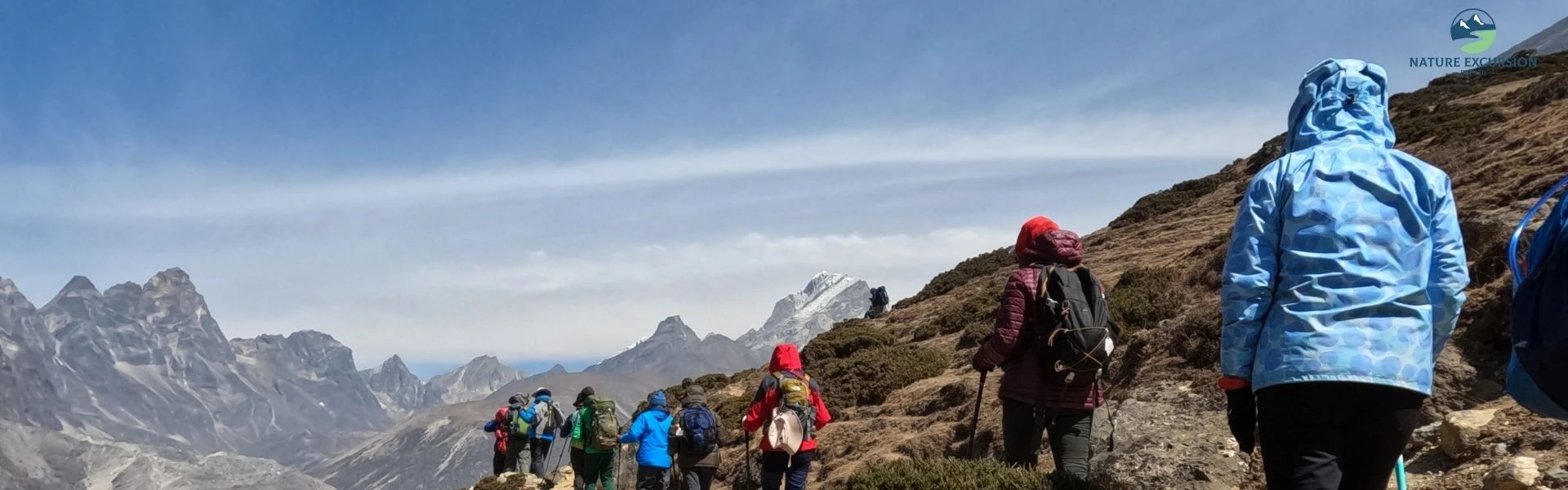
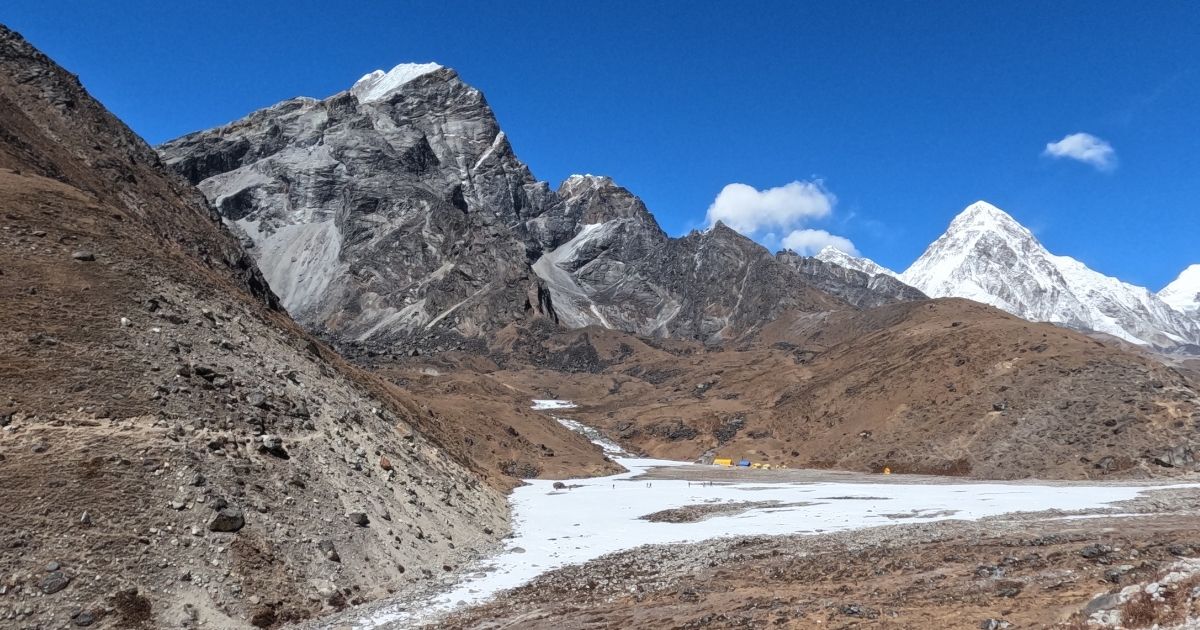
From Thukla you climb to Lobuche High Camp at about 5,400 m. Nature Excursion times this as 4 to 5 hours. The trail is steep. The air is already thin. You are still walking, not climbing, but this is where people arrive tired before the real climbing starts. Rest, eat, and practice the harness here. Summit night is a poor time to learn the buckles.
The Glacier From High Camp
At first light, you step onto snow and ice. The path changes with the season. Guides check for hidden cracks and keep the group on a rope when needed. Your job is to take even steps in spikes, move slowly, and avoid side trips for photos. This is not the hardest part. It is where sloppy feet waste energy you will need on the wall.
The Headwall (the steep wall, 45 to 60 degrees)
The headwall is a steep snow and ice face. In season, ropes are already attached. You clip in. You climb with a jumar in one hand, an ice axe in the other, and the front spikes of your boots in the slope. The wall is not a famous north face. It is still the hour when arms burn, calves shake, and breathing goes ragged. Practice the jumar before you fly to Lukla if you can.
The False Summit, the Knife-edge Ridge, and the Top
A bump above the wall looks like the summit. It is not. A thin ridge continues, with drops on both sides. That thin crest is what people mean by a knife-edge. Wind is stronger here than on the wall. You stay clipped. You do not rush. Guides will turn the group if gusts make the ridge unsafe.
The last meters are a short steep snow crest to the East top at 6,119 m. There is not much room. Photos are quick. You still have to reverse the ridge and the wall. Most trouble on peaks like this happens on the way down, when focus drops.
How Difficult Is Lobuche Peak Climbing for Beginners?
Beginners who already trek well at high altitude can climb Lobuche East with a guide. But it is not suitable for a complete beginner who has not slept above 4,000 m and has no practice in spikes.
The word “beginner” means two different people here:
- A beginner climber with trekking experience: A person may be new to climbing but still be well prepared for Lobuche East. This could be someone who has completed Everest Base Camp, Annapurna Base Camp, or another trek that reaches around 5,000 m, can hike 6 hours with a pack, handle cold weather and long trekking days, learn to use crampons, a harness, an ice axe, and a jumar, and stay calm.
- A first-time high-altitude traveler: Someone who only hikes short weekend trails at home and has never slept above 3,000 meters is usually not ready for Lobuche East. The trail to Thukla is already a full trek. Adding a steep snow climb at over 6,000 m can become difficult when you are tired, cold, and affected by altitude. This increases the chance of altitude sickness, cold feet, exhaustion, or needing to turn back before the summit.
Extra: If you have never climbed before, you can still go if you treat the practice session as required, not optional, and you accept that the guide may send you down from high camp if you are not moving safely.
Lobuche East vs Lobuche West
Lobuche East (6,119 m) is the climb in almost every package, including Nature Excursion’s 15-day trip. Lobuche West (listed as 6,135 m) is a harder climb on the same ridge of peaks. Same valley. Different mountain day.
| Feature | Lobuche East | Lobuche West |
|---|
| Height | 6,119 m | 6,135 m |
| Type of climb | Standard guided climbing peak | Specialist and more technical climb |
| What most climbers book | The usual Lobuche Peak climbing trip | Less common and for experienced climbers |
| Route conditions | Steep snow wall followed by a narrow ridge | Steeper mixed snow and rock climbing. Not a first 6,000 m peak |
| Suitable as a first 6,000 m peak? | Yes, for well-prepared trekkers with guide support | No, not usually |
| Foreign permit price in 2026 | USD 350 in spring; USD 175 in other seasons | Same permit price |
| Crowd level | Regular climbing groups in spring and autumn | Few climbing teams |
Both Lobuche East and Lobuche West are on the Nepal Mountaineering Association permit list at the same price. The permit cost is not the main difference. The climbing difficulty is. Lobuche West has steeper mixed terrain, less traffic, and fewer nearby lodge options.
Thus, if a trekking company’s itinerary or quotation only says “Lobuche Peak,” always ask whether it means Lobuche East or Lobuche West. You want East unless you already climb steep snow and rock at a high level.
Is Lobuche East Harder Than Island Peak Climbing?
Yes, for most climbers, Lobuche East is harder than Island Peak, even though Island Peak is slightly higher.
Island Peak’s hard part is a steep wall you climb on a rope, then a short ridge. Lobuche adds a longer, narrower ridge after you have already climbed a 45- to 60-degree wall. Also, the final 400 m of Lobuche East is where the climb feels more serious.
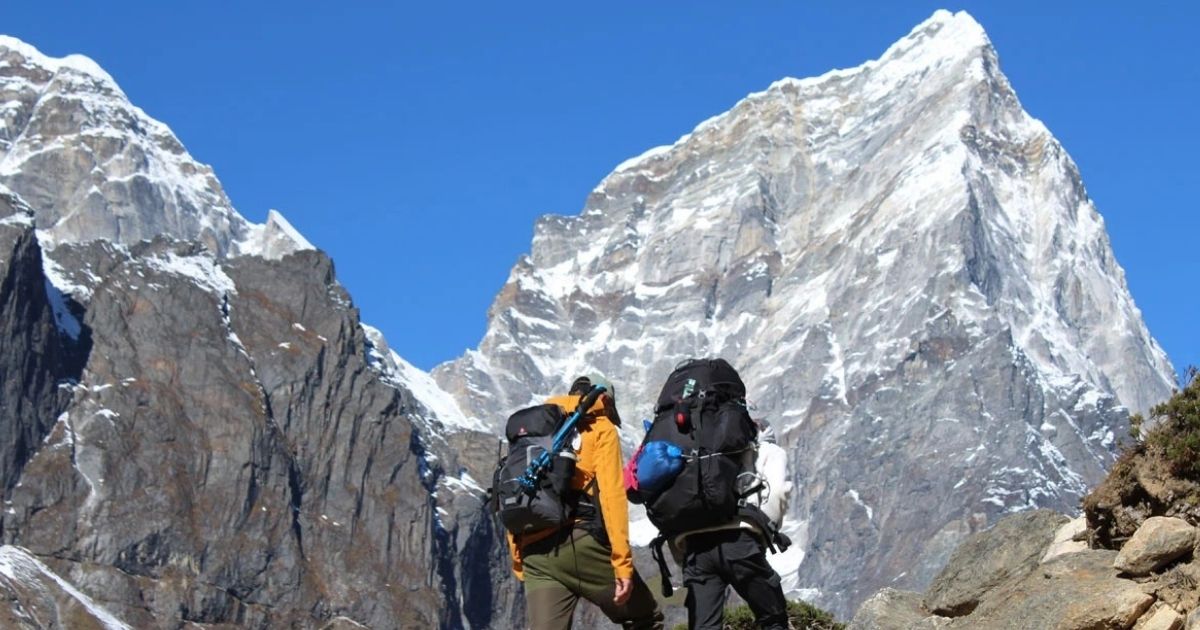
Island Peak has more glacier cracks and ladders, and a very steep last wall. Lobuche stays steep for longer on the ridge and asks for a calmer head with empty air beside you. If exposure bothers you, Island Peak is the kinder first peak. If you already move well on a rope and want a closer view of Everest, Lobuche East is the next step.
Not sure if Lobuche East or Island Peak is right for you?
Send us your trekking background and travel month. We will tell you honestly which peak fits, or if Everest Base Camp is the better start.
Island Peak vs Lobuche East vs Mera Peak
| Feature | Island Peak | Lobuche East | Mera Peak |
|---|
| Height most operators | 6,189 m | 6,119 m | 6,476 m |
| Summit route | Glacier travel, ladders, steep ice wall, then a short ridge | Steep snow and ice wall followed by a longer narrow ridge | Higher altitude but generally gentler snow slopes |
| Main challenge | Crevasses, ladders, and the steep final wall | Steep wall, exposed ridge, cold, and longer technical climbing | Altitude, long summit day, and endurance |
| Suitable as a first 6,000 m peak? | Usually yes | Best for trekkers with previous high-altitude experience and confidence with exposure | Often yes, especially for climbers focused on height rather than steep terrain |
| Nature Excursion trip length | 16 days | 15 days | 17 days |
Island Peak can be a better first technical climbing peak for a fit trekker who has already completed a high-altitude trek. Lobuche East is a good next step if you already move confidently on a rope, are comfortable wearing crampons, and want a more exposed summit experience with close views of Everest.
Mera Peak is higher than both Island Peak and Lobuche East, but it is generally less technical. It suits climbers who want to reach a higher Himalayan summit without tackling a steep ice wall or narrow ridge.
You can also combine Lobuche East and Island Peak climbing on a 20-day trip after a block of rest and acclimatization days. However, this is a bigger physical challenge, not an easier option. You need enough energy for two summit attempts at high altitude.
How Fit Do You Need to Be for Lobuche Peak?
You need good trekking fitness, strong legs, and enough stamina to keep moving safely during long days at high altitude for Lobuche Peak. Before joining the trip, you should be able to hike for 6 to 7 hours on back-to-back days while carrying a 6 to 8 kg daypack. You should also be able to manage one long day of around 10 hours on steep ground without becoming completely exhausted.
Likewise, for Lobuche Peak, strong lungs and hiking endurance matter more than heavy gym lifting. Summit day can last 8 to 12 hours, and you begin after sleeping at high camp at around 5,400 m. At this altitude, your body works harder even when you are walking slowly.
A useful fitness check is to complete a hike with around 1,000 m of uphill ascent while carrying a pack. You should be able to repeat a similar hike the following day. If one uphill day leaves you completely exhausted for several days, you need more training before attempting Lobuche Peak.
Thus, if Everest Base Camp felt like your physical limit, give yourself several months of extra training before Lobuche Peak. You can also consider Island Peak first if you want to build confidence with ropes, crampons, and high-altitude climbing.
What Technical Skills Are Required for Lobuche Climbing?
You need basic snow and rope skills before the Lobuche Peak summit day. You should walk in spikes on hard snow, use an ice axe for balance and a simple stop if you slip, clip the jumar onto a rope and climb it, slide down a steep section with a belay device (the metal tool that controls the rope), and stand still on a narrow ridge.
A good climbing team will usually provide a practice session in Kathmandu, at Lobuche Base Camp, or at high camp before the summit attempt.
That said, the most useful technical skills for Lobuche climbing are:
- Walking in crampons, the metal spikes attached to your climbing boots
- Using the front points of your crampons to kick into hard snow or ice
- Using an ice axe for balance and learning a basic self-arrest technique if you slip
- Clipping a jumar, or rope clamp, onto a fixed rope and moving up the rope
- Descending a steep slope with a belay or descender device
- Clipping your safety strap onto the rope without dropping equipment
- Standing and walking calmly on a narrow ridge
- Breathing slowly and pacing yourself above 5,000 m
You do not need to place ropes, build anchors, or lead the climbing route. The climbing Sherpa handles these technical parts. However, you need to be comfortable using the fixed rope system without pulling, twisting, or fighting with your gear.
How to Train for Lobuche Peak?
Try to train for 4 to 6 months before your Lobuche Peak trip. The goal is to build stamina for long trekking days, strength for steep uphill climbing, and confidence on snow and ropes.
Start with easy cardio training, then slowly add hills, stairs, and hikes with a backpack. If possible, spend a few days practicing on snow before coming to Nepal. Even a short snow and crampon course can make a big difference on summit day.
A simple training plan for climbing Lobuche Peak requires focusing on these training types:
| Training type | How often | What to do |
|---|
| Easy cardio | 2 times per week | Walk, run, cycle, or use a treadmill for 60 to 90 minutes at a pace where you can still talk |
| Hills or stairs | 1 time per week | Train for 40 to 60 minutes on steep hills, stairs, or an incline treadmill |
| Strength training | 2 times per week | Focus on squats, step-ups, lunges, calf raises, and core exercises |
| Long hike with a pack | Most weekends | Hike on uneven trails while carrying a gradually heavier daypack |
| Snow and rope practice | When possible | Practice using crampons, an ice axe, harness, jumar, and descender device |
One weekly session should copy the feeling of climbing uphill with gear. You can use a gym rope, stair climbing in heavy boots, or uphill walking with a backpack. This helps prepare your legs and upper body for moving on fixed ropes.
Squats, step-ups, lunges, and calf raises are especially useful because they strengthen the muscles you use while climbing the snow wall. Core training also helps you stay balanced on the ridge, especially when your backpack pulls your body backward.
A weekend snow course with crampon and rope practice can be more useful than another month of treadmill-only training.
How Much Cardio for Lobuche Peak Preparation?
Plan 4 to 5 cardio sessions a week. Two sessions should last 60 to 90 minutes at a pace where you can talk. One session should focus on hills, stairs, or incline walking for around 40 to 60 minutes. Keep this up for months, not two weeks before the flight. Summit day is a long day in thin air, not a sprint.
Strength work supports the cardio. Squats, step-ups, lunges, and calf raises twice a week help on the wall. Core work helps on the ridge when the pack pulls you off balance. A weekend snow course with spikes is worth more than another month of only treadmill.
Common Risks on Lobuche Peak
The common risks on Lobuche Peak are altitude illness, cold injury, a crack in the glacier, wind on the ridge, and empty legs on the way down. A helicopter from the upper mountain depends on cloud and a place to land. A climbing Sherpa cannot remove the risk. They can slow the group, set a better rope line, and call the day while you still have energy.
- Altitude sickness (AMS), and the two dangerous forms (HACE and HAPE): AMS is headache, nausea, poor sleep, and a dry cough above Namche. HACE is swelling in the brain. HAPE is fluid in the lungs. Confusion, a wet cough, or you cannot walk a straight line means you go down now. Talk to your doctor about Diamox. It is not a substitute for rest days in Namche and Dingboche.
- Frostbite and hypothermia: Summit morning is usually well below freezing, and wind can make it feel much colder. Cold toes, fingers, and facial skin can become a serious problem if you wear tight boots, wet gloves, or too few layers.
- Crevasse danger: A crevasse is a deep crack in glacier ice. Some crevasses are hidden by snow and may not be easy to see. Stay on the route chosen by your climbing Sherpa and do not walk away from the group or guide’s track.
- Wind on the ridge: This is the most common “we were so close” reason to turn around. The ridge can feel exposed even in calm weather. In strong wind, it becomes much more difficult and unsafe. There is no benefit in continuing along a narrow snowy ridge during a gale. A safe descent is always more important than reaching the summit.
- Summit-day exhaustion: The climb does not end after the steep snow wall. You still need to cross the ridge, reach the summit, return safely, descend the technical section, and walk down toward Pheriche.
- Rescue limits: Helicopter rescue is not always possible in the upper mountain. Helicopters need clear weather, safe flying conditions, and a suitable place to land. Cloud, wind, snow, and poor visibility can delay or prevent a flight. Your travel insurance should clearly cover mountaineering or peak climbing up to the height you will reach. A policy that only covers “trekking up to 4,000 m” may not cover Lobuche Peak climbing at 6,119 m.
Lobuche Peak Climbing Success Rate
There is no official public summit success rate for Lobuche East. Success depends on weather, snow conditions, acclimatization, fitness, climbing confidence, and how well each person feels on summit day.
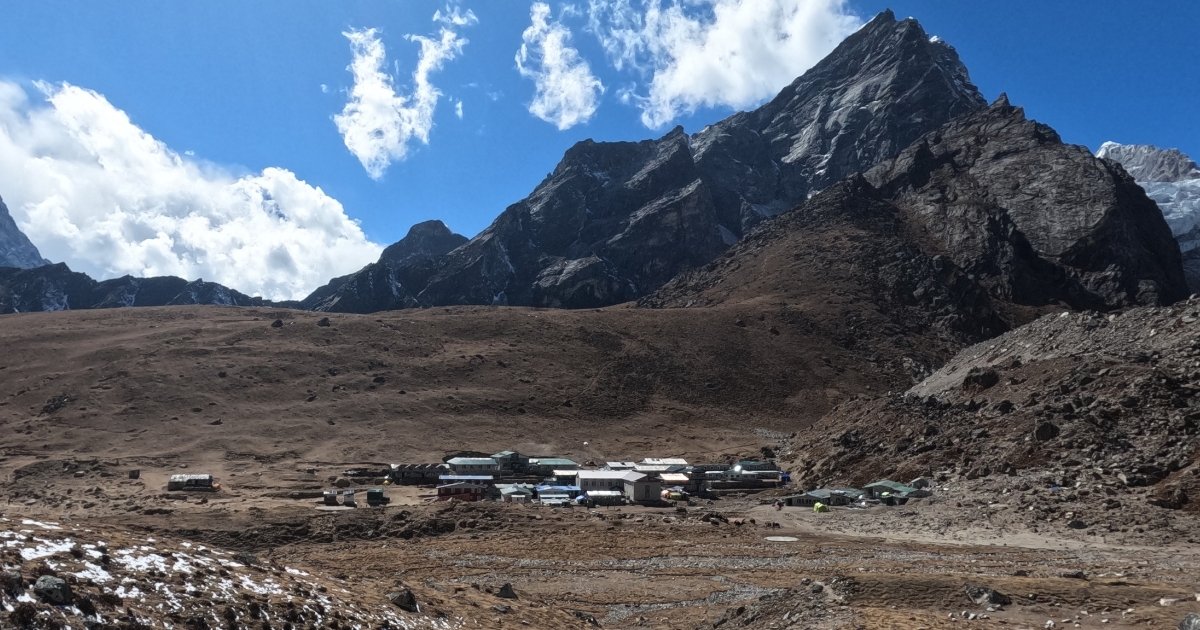
During a stable spring or autumn weather period, many well-prepared climbers in guided groups reach the summit. However, some people turn back because of strong wind on the ridge, altitude sickness, low energy, or slow movement rather than because the steep snow wall is impossible.
Who Should Attempt Lobuche East?
Lobuche East is a good peak if you have already trekked in the Everest region or at similar height, you want a real summit, and are ready to learn basic rope and snow skills.
It is not a peak to rush. You need time to train, acclimatize properly, and allow extra days in case weather delays the summit attempt. The climb is possible for a fit beginner climber, but it is not suitable for someone who is completely new to Nepal, high altitude, or exposed mountain terrain.
Lobuche East may suit you if:
- You have completed Everest Base Camp, Annapurna Base Camp, or a similar high-altitude trek.
- You have slept above 4,000 m before, or are clearly fitter than the average trekker.
- You can hike for long days and train regularly for several months before the trip.
- You want views of Everest and the Khumbu mountains from a 6,000-m summit.
- You are willing to practice using crampons, fixed ropes, a harness, and a jumar.
- You are comfortable following your climbing Sherpa’s instructions.
- You understand that weather, safety, and your guide’s decision come before the summit.
Lobuche East may not suit you yet if:
- This is your first trip to Nepal and your first time sleeping above 3,000 m.
- Narrow trails, steep drops, or exposed ridges make you panic.
- You cannot train more than once or twice a week before the trip.
- You only have time for a rushed 10-day itinerary.
- You are not prepared to turn back if weather, altitude, or safety conditions are not right.
Why Climbing with an Experienced Guide Makes All the Difference
A climbing Sherpa who knows this line is not a luxury on Lobuche East. They fix the ropes, read the wind on the ridge, run the practice session, and decide if the group goes up or down. That is the difference between a hard, fair day and a long, dangerous one.
On a well-run trip, you also get a slow walk-in with rest days, a spare day if the weather fails, group climbing kit that actually fits, and a small enough team that someone notices if you are fading. Nature Excursion’s 15-day plan includes that spare weather day. At high camp, we brief the jumar, spikes, and the descent before summit night.
Can You Climb Lobuche Without a Guide?
No. Foreign climbers should not climb Lobuche East alone, and in practice they cannot. Nepal’s mountaineering body issues the peak permit through a licensed agency. You also need the national park entry, the local Khumbu permit, and a climbing guide on the mountain.
A guide is not only paperwork. They choose the glacier line, keep ropes on the steep wall, read the wind on the ridge, and turn the group around while you still have energy. The glacier and the wall are not a place to teach yourself with no rope and no radio. If someone offers a “self-guided” Lobuche East, walk away.
When Is the Best Time to Climb Lobuche Peak for Easier Conditions?
The best time to climb Lobuche East is April to May and October to November. Those months have the most stable high-mountain weather, ropes already in place, and the best chance of a clear top. June to August is wet and a poor time for this ridge. Winter is possible for strong teams, but cold and wind make the thin crest much harder.
Valley weather is only half the picture. You need a calm morning on the ridge, not only a pretty day in Namche. For season-by-season trekking weather, see the best time to trek in Nepal.
Is Spring or Autumn Better for Lobuche East?
Autumn, especially October, is usually the safer first choice. The air is clearer after the rains and big storms are a bit less common. Spring (late April and May) is warmer on the wall, and the lower forest is in bloom, but afternoon cloud and late-spring snow can still shut the ridge. If you can only travel in March, wait until late in the month. Early March is often too cold and windy on this peak.
How to Check Lobuche Peak Weather?
Check a mountain forecast for Lobuche, then ask your guide what the ridge did yesterday. Look at wind and how cold it is near 6,000 m, not only rain in Kathmandu. Lodge reports from Dingboche and Lobuche help. Nepal’s weather office posts wider notices, but your guide’s morning call is the one that matters.
How Much Does Lobuche Peak Climbing Cost?
A guided Lobuche East climbing package in 2026 usually costs around USD 2,000 to USD 4,500 per person. The final price depends on group size, Kathmandu hotel arrangements, the number of guides, private or shared services, and whether you add another peak to the trip. Nature Excursion’s 15-day guided Lobuche Peak Climbing package starts from USD 2,390 per person, based on late August 2026 pricing. The price is reduced for larger groups.
Also, note that a cheaper quote that skips a spare weather day is not the same trip as one with extra hotel nights and a private Sherpa. Read what is in and what is not.
Cost of Lobuche Climbing Permit by Season
The Nepal Mountaineering Association climbing permit fee for Lobuche East is charged per foreign climber.
| Season | Months | Permit fee per foreign climber |
|---|
| Spring | March, April, May | USD 350 |
| Autumn | September, October, November | USD 175 |
| Winter | December, January, February | USD 175 |
| Summer | June, July, August | USD 175 |
These fees changed in 2025, so always confirm the latest amount before booking. Your trekking agency normally arranges and pays the permit as part of the climbing process.
Besides the climbing permit, you also need the same trail permits required for the Everest Base Camp region, and they are:
- Sagarmatha National Park entry permit, cost NPR 3,000 for foreign visitors in 2026 and NPR 1,500 for SAARC nationals.
- Khumbu Pasang Lhamu Rural Municipality permit, cost NPR 3,000 for foreign visitors in 2026.
You do not need the old TIMS trekking card for this route. The Khumbu local permit is used instead. Your agency should handle the paperwork for the climbing permit and trekking permits.
Estimate Your Climbing Cost
Find out how much Lobuche Peak climbing costs and what affects the total price, from permits and guides to accommodation and logistics.
What Gear Is Required for Lobuche Peak?
You need warm mountaineering boots that take spikes, a harness, a helmet, an ice axe, a jumar, a device to slide down the rope, crampons, a very warm down jacket, thick gloves and mitts, and a headlamp with spare batteries. Your boots are especially important. Buy or rent them early and walk in them before leaving for high camp. Do not wear new or untested boots on summit night.
Many operators provide shared ropes and may include metal climbing equipment such as crampons, an ice axe, harness, helmet, jumar, and descender device. Always confirm exactly what is included before booking.
What to Wear for Lobuche Summit Night?
Wear a base layer against the skin, a warm mid layer, a down jacket, a wind shell, two pairs of gloves (thin liners plus big mitts), a warm hat that fits under a helmet, and boots with room for toes to move. Add a buff for the face. You may feel warm while climbing uphill but become cold quickly when the group stops to adjust ropes or wait on the route.
Moreover, avoid cotton because it stays wet and cold. Avoid brand-new boots because they can cause painful blisters or cold feet. Do not rely on a single thin glove just because it feels easier to hold the jumar. Use thin liners while working with the rope and warm mittens when crossing the ridge or waiting in the cold.
Conclusion
Lobuche Peak climbing is challenging because of the steep snow wall, narrow summit ridge, high altitude of 6,119 m, and a long summit day that can take 8 to 12 hours. It is a real Himalayan climbing experience, not just a high-altitude trek. You need to use crampons, fixed ropes, a harness, and climbing equipment while moving on snow and ice. The thin air, cold temperatures, wind, and long descent also add to the difficulty.
However, Lobuche East is a realistic goal for trekkers who already have good high-altitude experience, train consistently for several months, and are willing to learn basic snow and rope skills.
That said, if you are not ready yet, there is no need to rush. Spend another season building your fitness, hiking on steep trails, and gaining high-altitude experience. Lobuche East will still be there when you are properly prepared.
FAQs
How long is the summit day on Lobuche Peak?
Summit day is usually 8 to 12 hours. You leave high camp around midnight to 2 AM, climb the glacier and the wall, walk the ridge, stand on top if the wind allows, then go down the same ground and walk to Pheriche. You do not return to high camp that night. The extra walk is why fitness matters as much as rope skill.
Can a beginner climb Lobuche Peak with no experience?
Not if “no experience” means you have never trekked high and never worn spikes. That base is too thin for a 6,119 m snow climb with a steep wall and a narrow ridge.
Is Lobuche East harder than Lobuche West?
No. Lobuche West is harder. East is the standard guided climb at 6,119 m. You walk the Khumbu trail, sleep at high camp, climb a steep snow wall on fixed ropes, then walk a narrow ridge to the East top.
West sits on the same ridge of peaks (listed at 6,135 m) and involves steeper mixed snow and rock. Few commercial groups go there. Permit prices are now the same. The climbing is not. Unless a quote clearly says West and you already climb at that level, you are booking East.
How long does it take to climb Lobuche?
Nature Excursion’s usual plan is 15 days Kathmandu to Kathmandu. That includes the Lukla flights, rest days in Namche and Dingboche, the climb from high camp, a spare weather day, and the walk out.
Summit day itself is 8 to 12 hours, from about 5,400 m to 6,119 m and down to Pheriche. Shorter trips exist. They cut rest. That raises altitude sickness risk and makes a weather delay harder to absorb. If your holiday is only 10 days, this is not the peak. Look at a trek instead, or add days.