Quick facts about Pokhara to Poon Hill distance
Fact | Detail |
Combined Pokhara to Poon Hill | About 62 km (road plus trail) |
Pokhara to Nayapul by road | About 40 km, 1.5 to 2 hours |
Nayapul to Poon Hill on foot | About 22 km via Ulleri and Ghorepani |
Ghorepani to Poon Hill | About 1.5 km one way, 3 km round trip |
Viewpoint altitude | 3,210 m / 10,531 ft |
Ghorepani sleep | 2,874 m |
Fastest walking plan we run | 3 days Pokhara to Pokhara |
Full plan we run | 9 days Kathmandu to Kathmandu |
Can you drive to Poon Hill? | No. Jeeps stop at a road head such as Ulleri or Banthanti |
Main villages on route | Nayapul, Tikhedhunga, Ulleri, Banthanti, Ghorepani, Tadapani, Ghandruk |
Typical walking hours per day | 4 to 7 hours on most days |
What is the distance from Pokhara to Poon Hill?
The distance from Pokhara to Poon Hill is about62 km when you add the 40 km drive to Nayapul and the 22 km walk to the viewpoint. People search this phrase expecting one number, and that is why so many pages disagree. A taxi does not take you to 3,210 m, and a GPS line through the forest does not match the stone stairs we climb after breakfast in Ulleri, so the useful answer is always two legs: road, then trail.

So, answering your question on how far is Poon Hill from Pokhara in walking terms, the answer is that from the Nayapul trailhead, it is about22 km on the classic route. How many km is the Pokhara to Poon Hill trek itself? Count only the walking days, and you stay near that 22 km to the viewpoint; then you add the descent on the way home, which is why a round‑trip Poon Hill walk from Nayapul sits closer to 40 to 50 km of actual hiking, depending on whether you return the same way or loop through Tadapani and Ghandruk.
If you are measuring for training, treat the trail as a series of steep up‑and‑down days with stone steps rather than flat kilometers. The same 12 km on this route feels longer than 12 km on a city path.
Where does the Poon Hill trek start?
The Poon Hill trek starts at Nayapul, a riverside road head about 40 km west of Pokhara. From Lakeside, you take a local jeep or taxi along the Modi Khola corridor, and you are on the trail by late morning. Most groups start between 7:00 and 8:30 AM from Pokhara so they can reach Ulleri before dark on Day 1. In peak season (October and April), jeeps can queue at the roadhead, so an early start helps avoid losing daylight in traffic.
The first walking hours are not mountain walking in the postcard sense. It’s because you follow the river toward Birethanti, pass farmland and stone villages, then climb through Tikhedhunga toward Ulleri. This is the same start we use on both the 3‑day short trek and the walking core of the 9‑day Ghorepani Poon Hill trek.
Nonetheless, some itineraries mention Kimche or a jeep drop at Ulleri, and those still sit in the same valley. They only change how much of Day 1 you walk, and they do not move the viewpoint.
How long does it take to trek from Pokhara to Poon Hill?
It takes most walkers two days from the Nayapul trailhead to sleep in Ghorepani, then a pre‑dawn hour to the viewpoint, so the sunrise itself is usually the morning of Day 3 if you start from Pokhara.
Add the drive from town, and you are looking at a very early Day 1 departure if you want Ulleri the same evening, which is why our own clocks look like the two plans below.
Plan | Who it suits | Clock from Pokhara | What you actually walk |
3‑day Poon Hill Short Trek | Short holiday, first Nepal trek, people already in Pokhara | Pokhara to Pokhara in three days | Day 1 Nayapul to Ulleri, Day 2 Ulleri to Ghorepani, Day 3 Poon Hill then down to a jeep at Banthanti |
9‑day Ghorepani Poon Hill Trek | Guests who still need Kathmandu nights and a gentler finish through Ghandruk | Walking days sit in the middle of a Kathmandu‑to‑Kathmandu trip | Same Ulleri and Ghorepani climb, then Tadapani, Ghandruk, and a Birethanti jeep back to Pokhara |
A one‑night Ghorepani Poon Hill Trek itinerary exists on paper, and we do not sell it, because the Ulleri stairs plus a 3,210 m sunrise with no recovery makes for a poor first memory of Nepal. If you only have two days in Pokhara, wait until you have three.
If you are coming from Kathmandu, add at least one full travel day to reach Pokhara by road (6 to 7 hours) or a short flight, then start the 3‑day trek from there.
Choosing the best route from Pokhara to Poon Hill
There is more than one way to walk this Poon Hill trek trail, but all realistic routes use the same core path through Ulleri and Ghorepani. The differences are mainly where you start walking, how much you let a jeep shorten the first or last day, and whether you return the same way or loop through Ghandruk.
The sections below break down the main route choices so you can match them to your time, fitness, and preference for crowds.
Classic Nayapul route
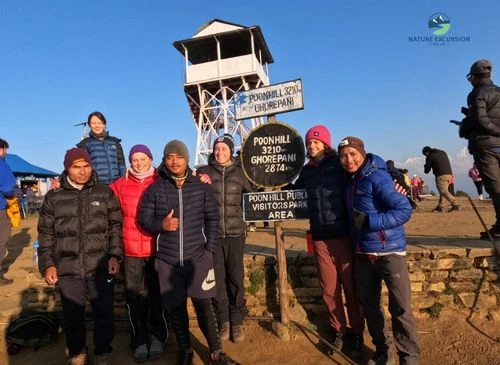
The classic Nayapul route is the one we still recommend to first‑timers. You start at the river, sleep in Ulleri after the stone staircase, next day sleep in Ghorepani at 2,874 m, and walk up to Poon Hill in the dark with a headlamp the next morning. The trail is paved for long stretches, teahouses sit close together, and you always know the next dining room is not far. This is why families and mixed‑fitness groups finish this trek and why an October sunrise at the viewpoint is rarely private.
Similarly, this route is well signposted and regularly patrolled by ACAP checkpoints. Mobile network and tea houses are frequent, but that does not remove the need to travel with a local guide for smooth trekking and cultural immersion.
Shortest route via Ulleri
The shortest walking route still goes through Ulleri, and there is no honest shortcut that skips those stairs and still uses the Ghorepani ridge. What people mean by “shortest” is a jeep that climbs toward Ulleri so Day 1 is shorter on foot. You save hours on the river path, yet you still pay for them on stone steps and still sleep at 2,050 m in Ulleri. If knees hate stairs, this is the day to use poles and a slow pace, not the day to hunt a secret trail.
Not to mention, jeep access to Ulleri or Kimche depends on road conditions and local rules, which can change after landslides or heavy rain. Even when a jeep goes that far, you still join the same footpath to Ghorepani and Poon Hill.
Jeep route to Banthanti
A jeep can take you closer than Nayapul, and on the way down you often meet a vehicle at Banthanti rather than walking all the way back to the river. On our 3‑day trip, that return drive is about 48 km and takes around three hours on a rough hill road, which is useful at the end of a sunrise morning and still is not a drive to Poon Hill.
Banthanti sits below Ghorepani, so the last walk to the viewpoint stays on a footpath, and that is the part you will remember after the journey ends.
If a brochure says you can “drive to Poon Hill,” ask which village they actually mean, because Ulleri, Banthanti, and Ghorepani are not the same place. Using a jeep to Banthanti shortens the return walk but does not change the main climbing days. It is most helpful for groups with limited time or weaker knees on the descent.
Poon Hill trek distance breakdown day by day
The overall trekking distance is split into days of about 5 to 12 km, which is why this walk feels less serious than Annapurna Base Camp even though the stairs are real. The hours below are our live itinerary hours, not a race time.
Three days from Pokhara (our short trek)
Day | Route | Distance | Hours | Overnight |
1 | Drive Pokhara to Nayapul, trek to Ulleri | Drive 40 km, trek 12 km | Drive 1.5 to 2 hours, walk about 5 hours | Ulleri, 2,050 m |
2 | Ulleri to Ghorepani via Banthanti | Trek 8 km | 5 to 6 hours | Ghorepani, 2,874 m |
3 | Ghorepani to Poon Hill, down to Banthanti, jeep to Pokhara | Trek 5 km, drive 48 km | Walk 3 to 4 hours, drive about 3 hours | Pokhara, 822 m |
On Day 1, the 12 km includes a steady uphill with many stone steps after Tikhedhunga. Day 2 is a mix of forest trail and ridge walking with views of Annapurna South and Dhaulagiri as you approach Ghorepani. Day 3 starts before dawn for sunrise from Ghorepani to Poon Hill, then descends through rhododendron forest to meet the jeep.
Walking core of the nine‑day Poon Hill trip
The 9‑day package spends Days 1 and 2 getting from Kathmandu to Pokhara (about 200 km, 6 to 7 hours on the highway). The trail days that match this keyword are Days 3 to 7.
Day | Route | Distance | Hours | Overnight |
3 | Pokhara to Nayapul to Ulleri via Tikhedhunga | Drive 40 km, trek 12 km | Drive 1.5 to 2 hours, walk about 5 hours | Ulleri, 2,050 m |
4 | Ulleri to Ghorepani | Trek 8 km | 5 to 6 hours | Ghorepani, 2,874 m |
5 | Poon Hill sunrise, then Ghorepani to Tadapani | Trek 11 to 12 km | 6 to 7 hours | Tadapani, 2,590 m |
6 | Tadapani to Ghandruk | Trek 6 to 7 km | 3 to 4 hours | Ghandruk, 2,012 m |
7 | Ghandruk to Birethanti, jeep to Pokhara | Trek 8 to 10 km, drive 38 to 40 km | Walk 4 to 5 hours, drive 1 to 1.5 hours | Pokhara, 822 m |
Day 5 is the longest walking day because the sunrise is only the first hour. After breakfast in Ghorepani, you still have a forest crossing to Tadapani, and that is the difference between reaching Poon Hill and finishing a proper Ghorepani loop.
Days 6 and 7 add cultural value: Ghandruk is a large Gurung village with museums, shops, and better lodges, which makes it a good final night before returning to Pokhara.
Can you drive from Pokhara to Poon Hill?
You cannot drive from Pokhara to Poon Hill, because a jeep or taxi only covers the 40 km to Nayapul, and even a rougher 4WD that continues toward Ulleri or Banthanti still leaves you on a walking ridge at 3,210 m with no road onto the platform. We still get this question every week at our office, usually from guests who have one spare day and a hired car, and our honest reply is that the car gets you to the trail while your legs do the rest.
Thus, if you have only one free day, you can drive to Nayapul or Ulleri and walk partway, but you will not reach Poon Hill and back in daylight without pushing hard, which is not ideal for a first hill day.
How difficult is the Poon Hill trek?
The Poon Hill trek is graded Easy, which means it is a first Nepal trek rather than an easy stroll. The hard part is the Ulleri staircase at a height where the air is still kind. You sleep at 2,874 m and touch 3,210 m at dawn, so this is not Everest Base Camp altitude, and serious AMS is uncommon if you drink water and do not race the stairs.

Headaches still happen when people treat Day 1 like a gym session. For the stair count, who it suits, and how we pace mixed groups, read the Poon Hill trek difficulty guide rather than repeating that whole page here.
For the Poon Hill trek, the fitness needed is that you should be able to walk 4 to7 hours a day on uneven ground and handle long stone steps. Regular walkers, active office workers, and families with teenagers usually manage well with a slow pace and breaks.
Do you need a guide or porter for the Poon Hill trek?
Hiring a guide is not mandatory everywhere in the Annapurna region. The guide requirement applies only in restricted sections and specific areas where local rules require it. On the standard Poon Hill route through Ulleri and Ghorepani, you can technically continue on your own.
We include a guide on both our 3‑day and 9‑day Ghorepani trips because it makes the trail smoother: the guide handles ACAP permit checks, teahouse bookings in peak season, pace and rest stops on the Ulleri stairs, and sunrise timing and weather calls.
A porter is not a legal requirement on the Poon Hill trek. However, having one often makes the difference between enjoying the Ulleri stairs and arriving with a sore back as your daypack quietly climbs to 12 kg, which is why most of our guests share a porter between two people.
Guides handle:
- Checkpoints if there are questions about permits or documents
- Teahouse bookings in peak season
- Pace and rest stops on Ulleri stairs
- Sunrise timing and weather calls
- Knowledge of alternate routes if the main path is icy or crowded
- Help with language in teahouses and with local customs
- Emergency coordination if someone feels unwell
Porters carry:
- Your main duffel (usually up to 15-20 kg, shared between two guests)
- Extra water or supplies if needed
- You still carry your own daypack with water, jacket, and camera.
Plan Your Own Adventure
Choose your destination, trip style, itinerary, dates, and pace to create an adventure that fits exactly what you want.
Transportation options from Pokhara to the trek starting point
Transport | Travel time | What it feels like | Best for |
Local jeep or taxi to Nayapul | 1.5 to 2 hours | Direct, early start, bags in the back | Almost every group |
Shared vehicle when seats exist | Similar clock, extra waiting | Cheaper, less control over departure | Solo travelers watching every rupee |
Private transfer | 1.5 to 2 hours | Hotel pickup, no hunting for a jeep at dawn | Families, older guests, tight flight days |
Jeep toward Ulleri or Banthanti | Longer on a rougher road | Shortens the river walk, bumpier ride | Guests who want less of Day 1 on foot, or a faster exit after sunrise |
Our Poon Hill Trek packages include the Pokhara to Nayapul vehicle and the return from Birethanti or Banthanti. If you are already in Lakeside and only booking the walking days, still leave town early, because the trailhead road clogs once tourist jeeps stack up, and a late Nayapul drop makes Ulleri a night arrival.
Road conditions vary by season. In monsoon, landslides can block sections between Pokhara and Nayapul, adding delays. In winter, fog can slow early morning starts. We build small buffers into our schedules in these seasons.
What permits are required for the Poon Hill trek?
You need an Annapurna Conservation Area Permit (ACAP) for trekking to Poon Hill. Our Ghorepani Poon Hill trek packages include the permit work, so you are not standing in a Pokhara office on the morning you meant to be in Ulleri. Carry your passport copies and extra photos anyway, because checkpoints still ask.
A TIMS card has been part of Nepal trekking paperwork in some seasons and not in others. We issue whatever the current rule requires when you book, rather than quoting a fee here that will be wrong by the time you fly.
Permit details:
- ACAP is issued by the Nepal Tourism Board office in Pokhara/Kathmandu.
- You need your passport, a copy of your passport, and passport‑size photos.
- Checkpoints on the trail (for example, near Birethanti and Ghorepani) may ask to see your permit and guide’s details.
How much does the Poon Hill trek cost from Pokhara?
A guided Poon Hill trek from Pokhara with us starts at USD 450 per person on the 3‑day short trek. The 9‑day Ghorepani Poon Hill trek starts at USD 745 per person. Both figures are live package starting prices, not a private‑room quote for peak October.
Piece | On our guided trips | If you try to split it yourself |
Pokhara trailhead vehicles | Included | Jeep or taxi to Nayapul, plus the return from Banthanti or Birethanti |
ACAP and current trail paperwork | Included | You still pay the conservation permit |
Teahouse bed and meals on the trail | Included on the published meal plan | Lodge rates change by season and by how full Ghorepani is |
Licensed guide | Included | Not mandatory on this trail |
Porter | Included or offered as a share, depending on the trip | Optional, strongly worth it on Ulleri day |
Kathmandu to Pokhara travel | Included on the 9‑day trip only | Tourist bus about 6 to 7 hours, or a flight you book yourself |
Budget extra for drinks, snacks, hot showers, device charging, tips, and a Pokhara hotel before and after the short trek. Those extras are not in the starting price, and they are the usual surprise, not the permit.
Typical extra costs on the trail:
- Bottled or hot water: USD 1 to 3 per item depending on altitude
- Hot shower: USD 3 to 6 in Ghorepani and larger villages
- Device charging: USD 2 to 5 per hour or per device
- Tips for guide and porter: commonly 10-15% of the trip cost, shared among the team
Prices rise slightly in peak season when demand for rooms and transport is highest.
Is the Pokhara to Poon Hill trek worth it?
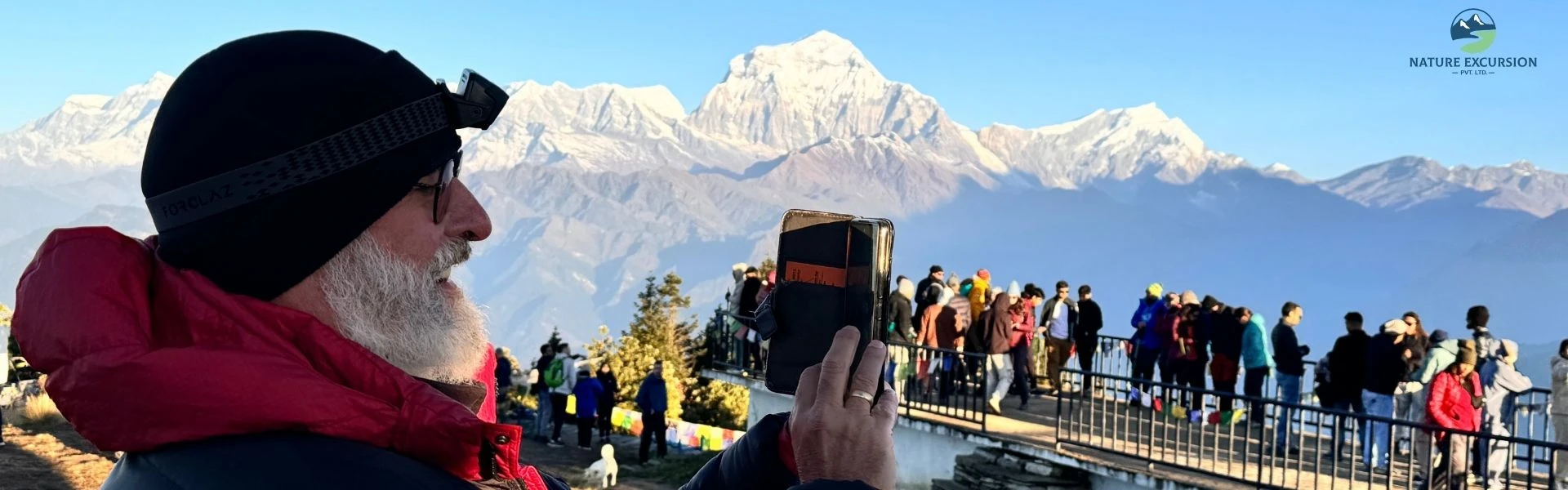
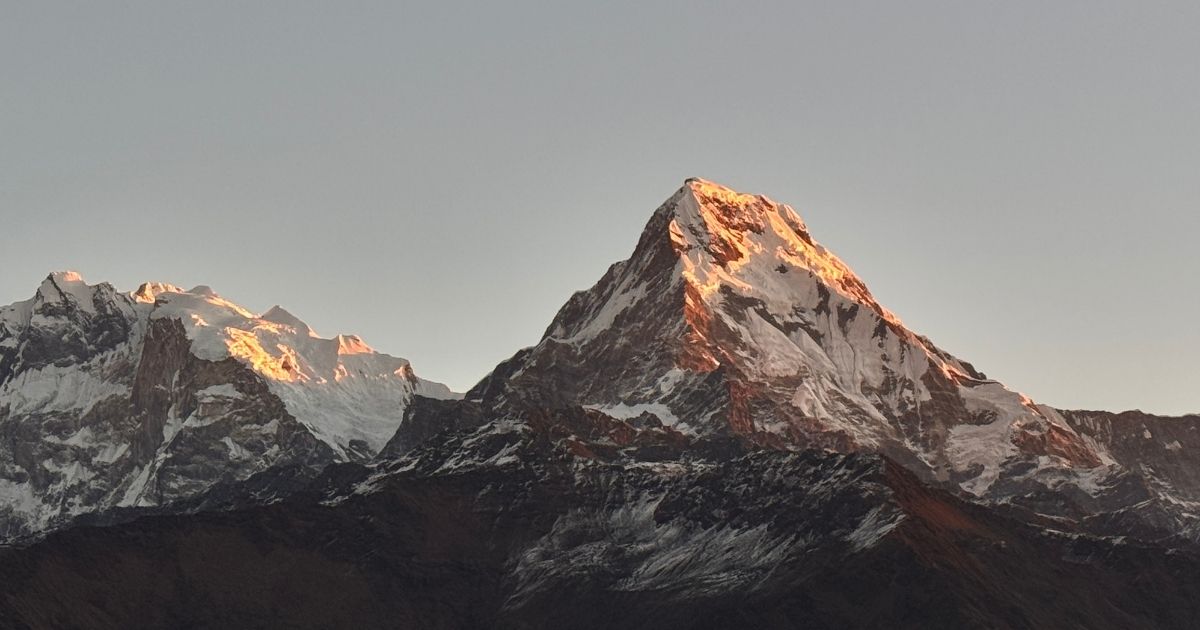
The trek to Poon Hill is worth it if you want a real Himalayan sunrise without two weeks on the trail. From the viewpoint, on a clear morning, you can see Dhaulagiri, Annapurna South, Hiunchuli, and Machapuchare while the valleys are still dark, which is why this small hill shows up in every Annapurna viewpoint list we keep.
It is less worth it if you expect empty ridgelines and no other people. Ghorepani in October is a busy village, and the last 1.5 km at 4 a.m. is a line of headlamps, so the light is still the light, and you simply share it.
This trek is especially good for:
- First‑time visitors to Nepal who want mountains without high‑altitude risk.
- Families with children who can walk 4 to 7 hours.
- Travelers based in Pokhara who have 3 to 5 free days.
- If your main goal is solitude, consider walking in late November, January, or early March, when crowds are thinner but mornings can be colder.
Should I choose the Poon Hill trek or Mardi Himal trek?
Choose Poon Hill if you want to sleep under 3,000 m, walk a trail with close teahouses, and finish in three to five walking days from Pokhara. Choose Mardi Himal if you want a quieter ridge and you accept a high camp near 4,500 m, which is a different body of work than a 3,210 m viewpoint.
Key differences in brief:
- Poon Hill: Lower altitude, more people, shorter days, classic sunrise viewpoint
- Mardi Himal: Quieter, steeper in parts, higher sleeping altitude, fewer teahouses on the upper section
Both start from the Pokhara side of the Annapurna region but use different valleys and ridges.
Poon Hill trek vs Annapurna Base Camp trek: which is better?
Poon Hill is better if you have a few days, you want a sunrise at 3,210 m, and you are new to Nepal trails. Annapurna Base Camp Trek is better if you have close to two weeks and want to sleep in the sanctuary at 4,130 m. Poon Hill is stairs and a viewpoint. ABC is longer days, higher sleep, and a different kind of tired, even though both names sit on Pokhara trip lists.

If Poon Hill feels too small once you see the mountains from the viewpoint, you can go for the Annapurna Base Camp trek. At Nature Excursion, we also offer a combined Annapurna Base Camp with Poon Hill Trek, which lasts for 12 days.
In brief:
- Time: Poon Hill 3-5 walking days; ABC 10-14 days
- Altitude: Poon Hill max 3,210 m; ABC around 4,130 m
- Effort: Poon Hill moderate; ABC moderate to challenging
Still Not Sure?
Wondering about the Pokhara to Poon Hill distance, route, or trek duration? Talk to our team for practical advice and trip details.
Conclusion
Pokhara to Poon Hill is a 40 km drive and a 22 km walk, not a single taxi fare to a viewpoint. Plan two days to Ghorepani and a third morning for sunrise unless you are on a longer loop through Tadapani and Ghandruk. If you are already in Pokhara, the 3‑day short trek is the best match for you. If you still need Kathmandu on both ends, use the 9‑day Ghorepani Poon Hill trek.
For dates and group size, contact us and tell us whether you are starting in Pokhara or Kathmandu, because that one fact changes the trip we book. Also, if you are unsure about fitness, season, or how many days you need, share your travel dates and past trekking experience on the contact form or WhatsApp, and we will suggest the right plan rather than a generic answer.
FAQs
How far is Nayapul from Pokhara?
Nayapul is about 40 km from Pokhara, and the drive takes 1.5 to 2 hours by jeep or taxi when traffic on the valley road is normal.
What is the distance from Nayapul to Poon Hill?
The distance from Nayapul to Poon Hill is about 22 km on foot through Tikhedhunga, Ulleri, and Ghorepani, including the last 1.5 km from Ghorepani village to the viewpoint. Most groups split that into two walking days plus a pre‑dawn hour, rather than trying to cover it in one push, because the Ulleri staircase sits on the first day and Ghorepani at 2,874 m is the place you want to sleep before sunrise.
How many days does the Poon Hill trek take from Pokhara?
The Poon Hill trek takes three days from Pokhara to Pokhara, which is the shortest plan. Two days to Ghorepani and a sunrise morning is the honest minimum if you want to walk the classic ridge rather than treat the viewpoint as a one‑night stunt. Four or five walking days feel better if you want Tadapani and Ghandruk instead of a jeep out of Banthanti the same day as the viewpoint.
Is the Poon Hill trek suitable for beginners?
The Poon Hill trek is suitable for beginners who can walk 4 to 7 hours on consecutive days and handle a long stone staircase. It is one of the easy treks for beginners in the Annapurna region, suitable for families and older guests with moderate fitness, because you sleep at 2,874 m and only reach 3,210 m at dawn rather than spending nights above 4,000 m. It is a poor choice only if someone cannot manage stairs or expects a flat lakeside walk with a Himalayan view attached.
What is the best time to trek Poon Hill from Pokhara?
The best time to trek Poon Hill from Pokhara is March to May and September to November. October and April have the most reliable sunrise and the most people, while late November and March are quieter and still clear on many mornings, so those shoulder weeks are what we suggest to guests who dislike a crowded platform.
What is the distance from Ghorepani to Poon Hill?
The distance from Ghorepani to Poon Hill is about 1.5 km one way and 3 km round trip, with roughly 350 m of climbing from the village at 2,874 m to the viewpoint at 3,210 m.
What is the altitude of Poon Hill?
The altitude of Poon Hill is 3,210 m (10,531 ft), and you do not sleep at the viewpoint. You sleep in Ghorepani at 2,874 m and walk up before dawn to Ponn Hill viewpoint the next morning.
Is altitude sickness a risk on the Poon Hill trek?
Altitude sickness is a low risk on the Poon Hill trek compared with Annapurna Base Camp or Everest, because you only reach 3,210 m and you sleep below 2,900 m, though it is not zero. People who sprint Ulleri, skip water, and add alcohol in Ghorepani still get headaches, and a headache at 2,874 m is a bad way to start a 4 a.m. climb. Walk slowly on Day 1, eat, and tell your guide if the dawn climb feels wrong.
How do I get from Kathmandu to Poon Hill?
You get from Kathmandu to Poon Hill by reaching Pokhara first. Once you are in Pokhara, the clock is the same: 40 km to Nayapul, then the Ulleri and Ghorepani days. There is no direct trail or road from Kathmandu to the viewpoint that skips Pokhara.
What should I pack for the Poon Hill trek?
Pack broken‑in hiking shoes, a warm layer for the 4 a.m. climb, a headlamp, a rain shell, a 20 to 30 liter daypack, and poles if your knees complain on stone.
What is the best route for the Pokhara to Poon Hill trek?
The best route for the Pokhara to Poon Hill trek is still Nayapul to Ulleri to Ghorepani, then the pre‑dawn walk to the viewpoint. It is the route all local trek guides know in the dark, and the route with the most teahouses. Likewise, clockwise loops through Ghandruk and Tadapani are a fine way to come down after the viewpoint.